The moment I recognized this would be a tragedy was during Spartacus’ great final speech to his army, when he tells them that they are better than the Romans, who are fat and surrounded by their slaves. Kubrick immediately cuts to Crassus, the human form of Rome, who is lean, and surrounded by centurions. By an audience’s standards, it’s subtle, but truly it’s a blatant farewell to the hopeful portions of the film, welcoming the long and merciless ending. jun19 07
brooks lord of flies
In reading it’s easy to forget a character’s complexion, so that in the novel one can forget that children are children, as they adopt adult tendencies; the film adaptation presents us with no such opportunity. The book is what changed my life–though I don’t deny I was prepared for a change to take place, as soon after reading it, some months later, my first depressions set in, and perhaps it’s this book that provided the impetus to pursue literature, which gave me the vocabulary I found necessary for depression. I don’t know–do people grow depressed who are not also well-read? I read this twice in a week, devastated, and ran off to the book store demanding literature that dealt with the subject of “human nature”–they were happy to give me Salinger, and so I first experienced that revelation of revelations, the one you’re supposed to have while reading Catcher. As fascinating as I found this book, the discussion in school was rather abstract and at best literal; the nearest we focused on interpretation was the statement made by Golding somewhere in his introduction or notes on the significance of the boys being rescued at the height of their war by civilized man, who more civilized than a British soldier? in the height of his own war. And so the rescue becomes a singular instance, rescue from the island, rescue from a specific struggle, but not rescue from the larger struggle, which is so vastly expanded, so impersonal, that we can overlook it. War is a struggle between states, not men, it is a distant struggle, subsisting by words in newspapers, words in textbooks, the injuries and deaths negligible by their quantification.
Golding, of course, addresses both the nature of man and of organized society. Throughout there is a need to reach the bottom of things, the bottom of society being the individual, the bottom of the individual being—the child? The basest instincts? The children begin by being isolated from one another, and with the meeting of Ralph and Piggy so begins the structure of society, that is, when Ralph names Piggy, despite Piggy’s suggestion of the name, so Ralph exerts his control over him. This we cannot forget, because though it doesn’t function as an “original sin”—which comes later in the film—it recalls the naming of Adam by God, and of Adam’s naming the animals. Ralph shows an excessive concern over the names of the boys, placing that as the foremost organization task. So we’re left questioning whether Ralph is pure as supralapsarian Adam, or as sinful as the sons of Noah and their attempted tower. Ralph, as the one character who maintains a belief and memory of an omnipotent England (Piggy relinquishes that memory when he denies the murder of Simon), perhaps the protagonist, has this cruelty hang over his head despite the goodness he intends throughout the rest of the film. Piggy remains Piggy. This suggests that Ralph, as the purest character, aside from Simon, who is more a concept than a character in any case, still is plagued with darkness and sin. He may not be so cruel as Jack, but he is cruel.
Our introduction to Jack is as he leads a small choir down the beach. His role as leader is already established. The song they sing, as the film progresses, is repeated as the boys become savages, yet holding a pretty quality. And finally, in the rescue scene, the song is played again, the sound of a military band, voicing a definite confidence. The band’s music provides a calm reassurance, as we know the danger has passed for the boys, and thus the comparison of boys and men, of savagery and civilization. Music has a unique quality of being something that, in its performance, requires no competition: both players and audience reap the benefits, nobody loses. This idea makes all the more poignant the turning of the choir into the band of hunters, whose function is to assure the ultimate competitive situation, even unfairly. It is this group who commits the “original sin” when they kill the sow by spearing her “right in the arse.” Aside from the obvious sexual implications, there’s also the fact that the sow is perhaps the only source of meat on the island. Unlikely, but that’s the impression given. She can create piglets, but nobody can create her. By the same token, these are the boys later responsible for burning down the island’s trees: the trees can create fruit, but nobody can create the trees. And thus, back to the sow, we are brought to the “lord of the flies”—which, as I recall, is the translation of the name Beelzebub, which in itself is a perversion of “Ba’al Zebub” or some such version of the Canaanite god. It doesn’t hold bad connotations until the bible attaches them, and I can’t help but recall Milton’s legions of hell. And this is where I always grow a bit stumped on meaning. Simon, who is something of a transcendentalist, who in the novel is subject to fits not unlike an ancient Middle-Eastern prophet, in the film takes on a Christlike quality, not only in his ritual murder, but also through his ability to instill life in those things that the other boys overlook, sublimating the mountains and the flies in his quiet scrutiny. Simon holds the only vestige of an ultimate higher power, something beyond England. When he suggests they climb the rocks, he questions whether there is anything else they can do; what else is there but to reach to the heights? And he maintains his reserve when he encounters the “beast” long enough to identify it and make his slow return back to the camp—where he is presently murdered—which gives him the power to destroy it, if only through identification of it, through a silent “naming” of the thing, the power of God, not assumed—like Ralph or Jack’s power—but granted.
This suggests to me that the “lord of the flies” is not the sow’s head left as an offering to the beast, nor is “the beast” the dead man in the parachute. As an offering, it might be said that Simon “brings” it to the beast merely through his observation of both. But it is through his virtual “naming” of the beast that he exerts his influence over it, making him something of the beast’s creator, and in his refusal to shy from the sow’s head and its resident flies, Simon is displayed holding a power over the “lord of the flies”—and when he is wrongly murdered as the beast, “wrong” is perhaps the incorrect assumption. Indeed, within Simon is the truth of the beast’s nature, and in his death the terrible secret remains. Simon is the lord of the flies, as he presides over their feast, as he gives definition to the beast. The boys kill him rightly when they act as if control of the beast is itself the exercising of evil, when we observe that the darkness and light may be mistaken for one another, when they are so nearly the same, when Simon tries to explain everything, to bring light to the boys’ fearful darkness, when the light of the boys’ fire casts the shadows that doom Simon.
So it goes in reality, the leaders and their followers preferring darkness to light, for the excuse to act savagely toward one another and toward nature, for the excuse to follow blindly toward a questionable salvation from the supernatural rather than a sure rescue within life. jun 28 07
Miller: The Colossus of Maroussi (1941)
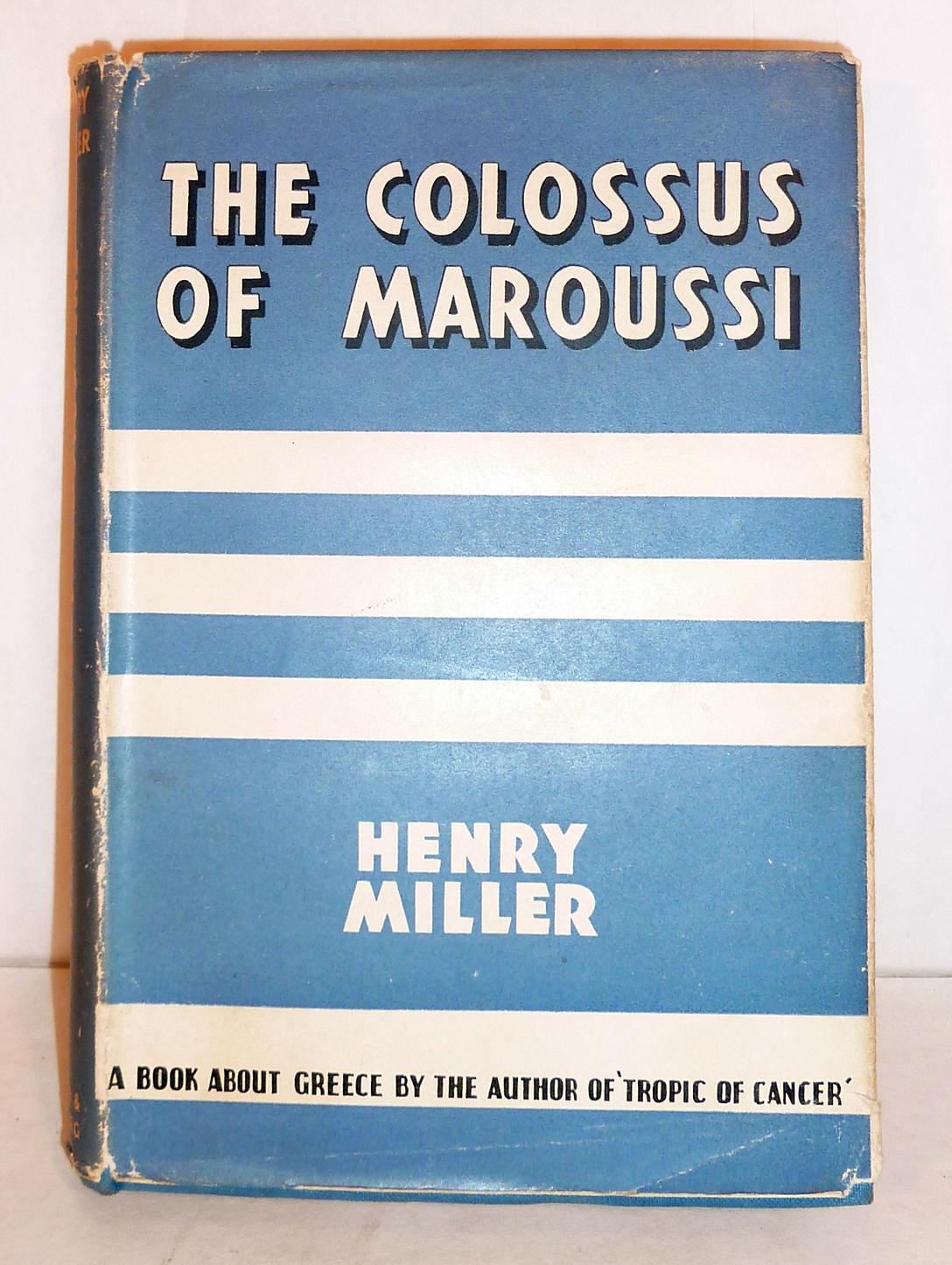
 I have one of the most remarkably poor memories of anyone I’ve ever met. Perhaps the very worst. What I can handle, though, is something a lot of people have told me is not only strange, but also difficult: I’m generally reading between 20 and 30 books at a time, and I stretch out reading them sometimes over years. It’s a bit foolish, but I seem very able to compartmentalize many parts of my life that way, so they exist in their own worlds uninterrupted. That’s characterized as a coping device as part of some disorders. How fascinating. So, judging by the book’s price, which was written in British pounds, I’ve been reading this book for two years. It’s a little over 200 pages. From the moment I began it I was enthralled in that way only Henry Miller and Anais Nin have ever done me. It’s essentially a travel book recounting Miller’s year-long vacation in Greece, and a remarkable account in that there’s nothing in vaguely erotic, which is usually Miller’s big draw. The emphasis is on Miller’s own experiences, his own transformation, and he makes clear that he does take some artistic license–and then the book isn’t really about Greece at all; it’s about Miller and his friends. His travels, the people, the sights, all are generally used to illustrate larger points–the sort of explanations that leave me breathless, unable to continue, always visualizing myself lost in space, but floating with determination.
Of course his Greece is much like his Paris, pre-War, and though he speaks in a recognizably modern voice, he lives in a world very much lost to us, I’m quite sure, as we all come to look the same and live electronically. In the book everyone loves Americans and America. They cheer us for saving them, and hope that we will save Europe from the war. I’m thankful that there was a Henry Miller writing during those years that I’m so fascinated by, and I wonder if perhaps he could have existed at any other time, if Henry Miller invented those years or they invented him.
I’ve decided it’s time to begin with Proust, who’s one of those writers everyone seems to throw the name around, whose work everyone has apparently read, though not me. So, it’s time to begin. july 5 07
film: Bauer: Умиращия лебед / The Dying Swan (1917)
july 8 07 Despite his short career, Bauer is supposed to rank up there with Griffith and Demille, but his work reminds me much more of Wegener in not only the dark subject matter, but also the emphasis on facial expressions. What this has which the others lack is a profound sense of beauty, the shots being set up to be beautiful, the subject matter beauty and its importance. The one shot that caught my attention was the introduction to a nightmare, during which we see Gisetta in bed, to the far right of the picture, and there is a “dolly out” shot, which moves backwards through room until Gisetta is centered through a doorway. Completely uncharacteristic of the film and its contemporaries.
Maxwell: The Married Virgin (1918)
Almost immediately this film breaks boundaries of the other films I’ve watched so far–this is more certainly Cinema than anything I’ve seen yet. Many reasons come to mind. The credits, so it introduces the characters one by one, little insights into their personalities, but the method of doing so in this film is different in that the characters do not look at the camera (compare to Amarilly of Clothes-line Alley, in which she wipes a window clean so the audience can see her face and then looks very smug), the audience, and even in their ignorance they don’t Appear to be ignoring anything, they appear Caught by us, as if through a keyhole. This is the norm now, but it seems to me a great step in a new direction then. There are many more cuts, showing different characters in their different situations, quickly one to the next, rather than focusing on a single scene and then moving on to the next scene. This is a firm step away from theater, where such cuts are simply not possible. Next, strides in movement, for the first take(?) of the film, the credits, is of two of the characters horseback riding–but not viewed from a distance, rather, viewed up close, alongside or before, such action, such movement of the camera itself is wildly new–reminds me of the horseback scenes by Feuillade, always stationary, the stationary shot in contemporary film being the more artistic one, the moving camera being overused and easy to overlook. Rudolph Valentino is a pure sex-symbol, he carries himself unlike any character I’ve seen so far, he is not in the film, he is merely alive–silent films are not lacking sound, rather, they don’t Need it at all, and he is the greatest proof of that without being overbearing, far from vaudevillian, he can be subtle, just as his co-star Kathleen Kirkham, who I’d like to fuck except she died in 1961, carries herself–something about tossing a woman into a thin nightgown and a rumpled bed really does it for me, when her hair is messy and down…yes, there was modern beauty in 1918. And this film is quite risque for the time too, judging by the other films that, when it’s time for a kiss, a crowd rushes in to block the viewer from seeing, this film has playful kisses, real ones, and introduces Mrs. McMillan by saying she’s too caught up in her extra-marital affairs to look after those of her home. I enjoy these films far more than I enjoy contemporary films–but really, it’s no good, falling in love with dead women.
Proust: Swann’s Way: ‘Combray’ (1913)
I don’t want to pit Proust against Lawrence, but they simply beg to be tried, and how particularly funny, that it is a Frenchman being pitted against a Brit, and losing, for the time being, in terms of passion. I would not have considered comparing the two except that in Lady Chatterley, Clifford Chatterley is reading “a French book” and the following argument begins thus:
‘Have you ever read Proust?’ he asked her.
‘I’ve tried, but he bores me.’
‘He’s really very extraordinary.’
‘Possibly! But he bores me: all that sophistication! He doesn’t have feelings, he only has streams of words about feelings. I’m tired of self-important mentalities.’
‘Would you prefer self-important animalities?’
‘Perhaps! But one might possibly get something that wasn’t self-important.’
‘Well, I like Proust’s subtlety and his well-bred anarchy.’
‘It makes you very dead, really.’
‘There speaks my evangelical little wife.’
Anarchy and Bolshevism are the two political systems thrown around by characters in Lady Chatterley. I’ve always thought of anarchy as something idealized by rebellious teenagers, rich teenagers, and if all I knew of it was the definition given by the OED, I’d suppose it was simply the central tenet of the Republican party, “absolute freedom of the individual.” The catch, of course, being fairly Christian in nature, that everyone has an immutable position in society, that there will be the happy, and there will be the unhappy. And, of course, without a ruler, the happy may flourish by suppressing the unhappy by whatever means are necessary. Bolshevism, in this case, means that the miners, people who Lawrence suggests were born with the mines (though, reports on BBC lately insist that the death of the mines in the 1980s did not bring about the death of all the miners) deserve much more than Clifford Chatterley, with his nothing legs and nothing penis. Even Mellors rose through his own hard work, language abilities, and eventually through his service in the military. Making it through Proust’s “Combray” only shows the world through the eyes of a child, at least Proust as a child, which doesn’t particularly say much, as I’ve seen the questionnaire he filled out as a little boy, and he was an adult even then. But perhaps the most we can say is that he is raised in a house filled with people who don’t seem to work, whose lives consist of “enjoying themselves” as Connie might call it. Are they dead?
I’m not quite sure how old I was when I began reading Anais Nin’s first diary, but at the time I was firmly opposed to consumption of alcohol and drugs, and it was Nin who gave me the best argument I’d ever heard. I’m a writer, she said, and she has to have her wits about her at all times because she must later write all that she experiences, and alcohol or drugs would hinder that. Well, I considered myself a writer, so it seemed a good enough argument, though I don’t think I ever had to use it. I think I felt betrayed later, when she and June were a bit drunk together. It was Nin who led me to both Lawrence and Proust. Connie says, ‘he doesn’t have feelings, he only has streams of words about feelings,’ and ever since she commented thus, I’ve been reading him through her eyes. Because, when it comes down to it, what would I rather be: the creator of something beautiful? or something beautiful myself? No contest: I’d rather be beautiful. I’d rather live a work of art.
But I think Proust dodges the question quite gracefully in showing something else, that there’s a third possible answer to that question: can one’s memory be a work of art, even if the reality was not. Indeed. And perhaps that’s what his work is, not meant to be engaged in so much as to be imbibed, we’re back to Shelley’s ravine. I find myself not caring about whether or not the narrator is reliable, because somehow this is a work about memory, and memory is allowed to be grandiose. Is it passionate? I find myself unable to recall the moments of the most heightened passion in my life, perhaps it is then that I become entirely an animal, and when I am in the moment, I am truly in the moment, unable to do what I usually do, to figure out what words I will later use to describe this, to be writing and editing while living, periodically disappearing to write down conversations and descriptions and then popping back into life, perhaps when there is no past, and there is no future, one simply loses the ability to recall that moment. I’ve always hoped there would be somebody else with me who would write down our experiences together, so that I didn’t have to be the only one, so that the memory could be more colorful, but nobody ever has, it’s a sad thing.
Perhaps, then, it’s worth noting that the sex scenes in Lady Chatterley begin very explicit, when she’s not particularly involved in the moment. And as she becomes increasingly involved as the novel continues, they become more metaphoric, more symbolistic, and if arousing, then arousing on such a deep physical level as to be almost spiritual, and then finally, the sex is not described at all, and everything surrounding it is, the ripped nighties, the flowers woven into her maidenhair, and her observations of others and their sexuality.
One night when I was sleeping on H’s sofa, he was sitting very close to me in a wooden chair, smoking pot and talking me, not caring if I was listening or sleeping, and he said “I don’t know what you think of my girlfriend, but I’ve slept with a lot of girls, I’ve seen a lot of girls naked, and it’s come to the point where I don’t even need to see them naked anymore to know precisely what they look like without their clothes on. And perhaps you can’t tell just by looking at her, but my girlfriend is perfect, there is nobody in the world more beautiful than she is.” As one gets older the more one understands any given person’s carriage, all that it indicates. At one time I thought it was all guesswork, but now, like H., and like Connie, I begin to understand. A little.
Byron – Occasional Pieces (1812)
Byron may be the most questionably reliable author I know of, even more so than whoever wrote The Things They Carried, so that by 1812 I’m still wondering if he’s telling the truth…does he really feel such sadness? Could it have taken the death of someone he loved for his writing such serious verse? Does it matter? In this case, I think it does, because Byron is his poetry in the same way that Shakespeare is not, it seems to me a mistake to read into Shakespeare by reading into his works, including the sonnets. Petrarch may bring to mind a proper example of how I feel about Byron at this juncture, because I’ve never, not for one moment, trusted Petrarch, and I think history treats him precisely as he wishes to be treated by it, rather than how I think he is–that is, I do not trust Petrarch’s religious fervor as anything other than spectacle–if a Shakespearean sonnet is about fucking, a Petrarchian sonnet is about not getting fucked for a very, very long time, and trying to deal with it. So do I believe Byron, or do I think he’s making use of the speechless dead, stirring up emotions that weren’t there until they were useful. Whatever the truth, his writing is much more grave and solemn, though with somewhat crudely lilting meter, until I reach this stanza of “If Sometimes in the Haunts of Men”:
For well I know, that such had been
Thy gentle care for him, who now
Unmourn’d shall quit this mortal scene,
Where none regarded him, but thou:
And, oh! I feel in that was given
A blessing never meant for me;
Thou wert too like a dream of Heaven
For earthly love to merit thee.
His usage of “him” directly before the commas on lines 2 and 4, and the subsequent commas, throw the meter and rhyme off slightly, but it’s still in perfect form, the words follow the pulse, but the punctuation does not. I always try to read poetry without forcing a pulse, just to feel how the words naturally rest, and this caught me entirely off guard, and delighted me. It reads to me like this:
For now I know, that such had been thy gentle care for him,
who now unmourn’d shall quit this mortal scene,
where none regarded him, but thou:
And it’s quite beautiful, even the very sound of it, and I think this illustrates what 1812 does for Byron, then, beyond developing the essential Byronic character further, it’s his breaking rules, in a sense, by owning them–for the first time I feel as if he has complete control over the poetic form, and it no longer restrains him but rather gives him new freedoms. If clothes do not fit on your body, they are not clothes; if a cuisine is not edible, it is not a cuisine; I think all the arts lead back to one’s body, and if poetry does not fit in one’s breath, it is not poetry–this stanza simply thrills me.
film: McG: Charlie et ses drôles de dames (2000)
That’s how they translate “Charlie’s Angels” in France…isn’t that funny?
I can’t figure out how it translates, actually. Charlie and his funny ladies? Charlie and Some Funny Ladies of His.
Whatever, I saw it in French, and I loved every moment of it, though I had to shout “what’s happening!?” a whole bunch when things got really exciting! I just wanted to mention that I’d seen it because the title is so fucking amazing.
film: Wright: Hot Fuzz (2007)
I’m not going to try extracting anything from this, because I don’t know if I’ve ever actually seen a cop-action-flick or whatever this movie is based on. But, I will say that I’ve spent the past week working on a website for a yoga center and it only just now occurs to me that on all the breaks during which I’m eating I’ve been watching extremely violent cartoons, and then tonight Bubba and Ash came over to do laundry, and they brought pizzas and Budweisers and we watched this movie. And the truth is that it’s very well done–it’s not “hilarious” like I was promised it would be, which is wonderful, because everytime I’m promised something will make me laugh I end up having to fake my smiles all evening. But this one was made smartly, it can’t quite be pigeonholed in a genre, and just, overall, while it may prove something I’ll forget, it was enjoyable to watch, I mean, I enjoyed watching it, and that’s more than I can say for most films.
But that’s not to say I rated this on Amazon, because as enjoyable as it was, I don’t want it tainting my Amazon recs.
Byron – Occasional Pieces (1811)
1811 is an interesting year for Byron’s work, because it ends on such a vastly different tone than which it began. It ends with two poems to Thyrza, and looking ahead, it seems Thyrza is a name he dotes on for quite some time. In itself, this is unusual, given the number of women who tear out the young Byron’s heart until this point. Early 1811 poems continue much the same as those few from 1810, halfhearted love-pieces, fragments, translations, bits of humor about travel, and at times as in ‘To Dives’ we get the sense that he’s trying to write from a height he simply cannot believe. So we move from:
Then, in my solitary nook,
Return to scribbling, or a book,
Or take my physic while I’m able
(Two spoonfuls hourly by the label)
to:
The pledge we wore–I wear it still,
But where is thine?–Ah! Where art thou?
Oft have I borne the weight of ill,
But never bent beneath till now!
A stanza that recalls many of his earliest pieces to girls who promised their love and then ran off. But something about this writing is more believable, perhaps it’s the simplicity and the loss for words, it seems far more emotional than his early work, more desperate, more pleading, and Byron’s treatment of death turns from a teenage fantasy to something far more real. In October he’s writing about her, and in December also, and looking ahead, into February still. Of course, I don’t know if she is real, and if not, then Byron has merely matured on his own–but I’ve been looking for a turning point, and up until now 1811 didn’t seem to offer much hope of one until I reached these poems today. Finally appears the man who will write Don Juan
Sweet Thyrza! waking as in sleep,
Thou art but now a lovely dream;
A star that trembled o’er the deep,
Then turn’d from earth its tender beam.
But he who through life’s dreary way
Must pass, when heaven is veil’d in wrath,
Will long lament the vanish’d ray
That scatter’d gladness o’er his path.
 arts & fetters