 I claim to be a writer if I’m pressed for a real answer, something better than “drug dealer.” But the follow-up question is always brutal: what do you write? Well…I used to consider myself a short-story writer, and then I thought I was writing a novel that turned out to be poetry…and what now? Love letters. I write very little other else. Usually I send them to Nathalie. I sometimes wonder if I enjoy them more than I enjoy love itself, for I do admit thinking, while in the throes of love, of what words I’ll be choosing to translate this into, for in my love letters I can draw you shining, and leave to drown the ways you failed, I can make something perfect, and if you saw it you’d be so pleased to know just how beautiful you looked that night. I also know the fervent apocalypse of the shades drawn all day, drinking the air humid and acrid, eating your breath, smoking your fingers, swallowing your words instead of my pills. That’s the nature of the writer, I suppose, who makes many decisions based on what experience he’ll gain to write about, no matter how foolish, unnecessary, or unhappy those decisions will be. I’ve paid the price many times, and those who care about me have tried to put a stop to it, but honestly, what else can I do?
—I have to go to sleep, honest, I have work in the morning…
–Please, Stephen, don’t you see? I’m leaving soon, tomorrow is my last night, and then that’s it, that’s it for a very long time. Maybe we’ll see each other again, but look at us, look at how we live, can you tell me that we’ll be alive next week? Stay awake with me tonight. Stay awake, because this might be our last chance together.
–I will.
I’ve been claustrophobic between my sheets, alone, and I’ve had to crabwalk over bodies, dress silent, fly out to the streets to fill my lungs, and I’ve felt my whole suckled, curled up freely, cool, sweet breezes under ten blankets, she’s pretty but she’s ruined, pretty but her teeth are fucked up, she wants to drop out but she wants to have a baby, I’m not used to numbers this big, the blood hasn’t stained my hands yet, but it will, I’ve even felt like a bird when your legs were thundering on my ears, I know the sound of your blood, some kid is picking flowers out of his eyes and digging for food in the trash in Bosnia, I don’t need to be in your pants, but I need to be in your hands, I don’t want to get off, but I want to fuck you, I don’t want to love you, but I need to feel like I do.
And do I fall in love easily? This question has two answers. One, yes: Nathalie envies me for this, the way I can move on always juggling prospects and deeply enthralled day by day, how I fall in love with someone every time I ride the bus, and how I forget her face soon afterwards. Four, yes, I want to wear a housedress and bake pies and connect the freckles and end the series at the peak of its ratings. Three, yes, no, no, no, I’ve been in love, I have so, and because it was so wonderful, I can never do it again, and I have to die young. Two, no: I don’t fall in love at all. Recently I felt very mournful that I had no more love to give, that I had given all the love I possibly had within me, and that these girls that I was trying to get involved with, well, I had nothing left for them. It turned out to not be true, because I had Byronic depression for one, and Achillean rage for the other. And everyone gets a love letter, it’s like a party favor, and that doesn’t make it meaningless, because the truth is that my entire soul is poured into these letters, they’re my only art, and if I did not have them, I don’t think I could bear to live. I fill up with a terrible passion, anger, sentimentality, and it burns in me until I can write it down, writing destroys things from my mind, they go into the paper, and you’d have a difficult time forcing me to recall anything I’ve ever written about if I’ve written about them to conclusion. Does a love letter mean I love you? Eh, not necessarily, and it doesn’t mean that I could love you either. They’re called love letters because there’s a not another term for them, and my prosaic virtues others tend to find intense, overwhelming, debilitating, in short: lovely. Most of my friends have received them from me, and I’ve received many from them, and there’s nothing else that feels quite so wonderful.
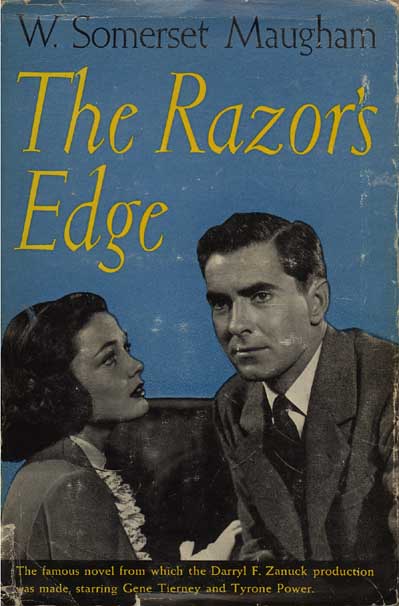
When I met her, I quickly ran home and went through my tens of thousands of books packed away to find my collection of Maugham, whom she considered “the most underrated novelist in the English language,” and whom I considered very dull, whose character development was restrained to how far one’s belly protrudes and whether or not one’s shirttails are flapping. This belief was founded on my reading of The Painted Veil, being one of my least favorite novels of all time. I’d vowed to throw out everything I owned by Maugham, and I found his books deep in a stack of advanced physics and astronomy textbooks. Who am I kidding? I began reading The Razor’s Edge, to impress her, of course, and fell in love with it immediately, as he introduces the story as being a true story, and explains the outcome, and all the ways he will fall short as an author, being unable to duplicate the language of Americans naturally.
The Painted Veil is remarkable for its being the only book he wrote in which plot held preeminence over character development. The story goes: a woman cheats on her husband, he forces her to come with him to a plague-ridden town so that she’ll die. He dies. I think she goes on to cheat on him. Or maybe she dies too. The point being, his emphasis on plot fails to make even a good story. The plot of Razor’s Edge: there’s some people, they come and go, oh, and at the end somebody admits to having effected something we didn’t find particularly remarkable earlier in the book. And yet it’s a page-turner. Is it the language? The language is often difficult, as I learned the names of more fabrics, garments, viands, and brands than I could ever remember, though I’ve made a nice list of them just in case. In the end it’s a character study of many individuals, all of whose lives I could take up immediately if I so please. And in the center is the author-narrator, who lives a very moderate life, cares a bit for everyone, but needs nobody, and although everyone thinks very highly of him, they care little for him. Nearly all my close friends fall into the category of “Sophie”—drug addicts and alcoholics, using sex to make money or just to survive, who once wrote as poets and now live as poets, whose lives have become mechanized within some romantic framework, and whose deaths are imminent. And then there is Isabel, sharp, dawdles with the poets, but ultimately chooses an existence based on stability, leads a fairly uninteresting life, and whose immorality derives from passive attempts to reanimate their own dead youths. I’ve never met anyone like Larry. He’s who I strive to be…and yet, I enjoy the transitory pleasure far too much… He is not a “beat”—because he values knowledge, and experience finds its way into his life via his quest for knowledge. And in my life, as I’ve noted above, knowledge seems to find its way into my life via my quest for experience.
She and I stopped talking, abruptly, and I wrote her a 20,000 word letter. And then I had no more feelings, and then I could move on, afraid that I’d never feel anything again. I’d gotten a subscription to the New York Times so I could discuss its editorials with her. I canceled it. The book she recommended continued to be enjoyable. And as soon as I finished it, I looked up from the pages, and there beside me was a woman who was also looking up from her book, and I gave her my copy, and she taught me a few things, wrote me a very pretty note, and I’ll probably never see her again. I had my moments with each of them. Sophie has her throat slit and her body cast into the ocean, the socialite Elliot rots to death (I recognize that experience–finding that most of one’s friends are phonies when one is dying, you fucks), and everyone else seems doomed to live without love. Forget, forget everyone, forget love, close your eyes in these vast expanses of time, especially the middle years… That’s what Razor’s Edge teaches me to do, teaches me to allow life, and more specifically, people, to wash over me, and wash away as they will, to half expect them throughout life, but to expect, no matter how I live, no matter what I do, to die alone and anonymous. But what about those of us who write love letters? What are we to do?
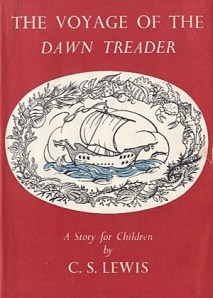 This is the third book of the Narnia series. It seems that it will be the last of which the original main characters take part, which leaves me a bit sad, because I took a great liking to Lucy instantly, despite her being the one with the most blind faith. Of course, all of the characters are idiots for not pointing out that Aslan bears a resemblance to Jesus. Maybe they’ve never been to church before. One of the arguments against Harry Potter, as I recall, was that it acknowledges supernatural powers aside from god, which don’t, of course exist, which makes it throughly heretical. The bible, on the other hand, doesn’t say such things don’t exist, but merely demands that they do not be used, I mean, that it’s wrong to raise spirits from the dead, and that it’s wrong to worship the other gods. Which is why I like the beliefs that include the other gods, so that the story goes that Jesus banished the Roman pantheon, and Venus went and hid in a mountain, etc. etc. Lewis, because the Christians know him to be one of their only supporters given credit by non-Christians thus should be able to do no wrong. He’s yet criticized for including mythical creatures in his work, including Bacchus. Any heavy-handedness is very brief, and his occasional asides and observations also very funny. The narrator makes clear which questions one should not worry about, that is, which questions he has no intention of answering, which keeps things moving along better than, say, Lord of the Rings, which has far more information and dead ends than anyone could make sense of (hence the endless tomes of further explanation). This is a classic “voyage” work, like the Odyssey or Gulliver’s Travels, in which the characters go from strange land to strange land and have many adventures. The difference between those works named above and Lewis’ is that Lewis allows his Aslan to keep the characters in line throughout the whole voyage. Inescapable terrors, dangers, tiffs, and slight moral questions are all set right by Aslan, which helps keep the plot from becoming too complicated, and also allows his ingenuity to be placed entirely in inventing magical delights and settings, and not having to bother figuring out how to save his characters. He even throws in Coleridge’s albatross for good measure, and though I was quite sure someone would shoot it, Lewis shows what would happen to a crew who let the albatross live. So they survive. This work was also more engaging than the previous, which was in turn more so than its previous.
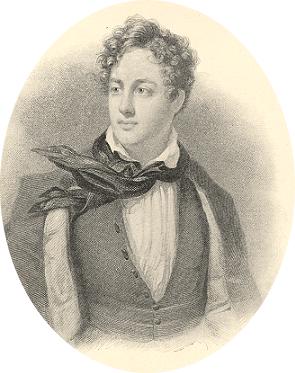 Four selections from a book of poems I find a somewhat tedious read of sporadic quality:
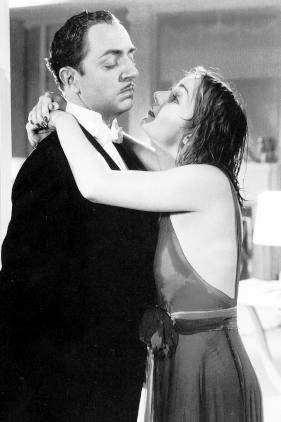
 arts & fetters