Show: Circus Folk Unite!: Zoomorphia (2008)

Hampshire College, 5 April 08.

We were hanging our bodies off the side of a railroad bridge, the gorge swaying beneath us, we had taken a long walk, and I came to realize during these days all the things I needed in life, and when I returned to school I went straight to the dance department and told the head of it that I wanted to change my course of study from English to dance, because I want to sing and dance, and that’s all I want to do, and I want to do it forever, because nothing makes me feel more pleasure. Perhaps there’s one other thing: and that’s song and dance with someone else, improvised, that, as if in a musical, begins without warning and ends, breathless gasps. It reaches a point at which I know the taste and scent of a person just by his or her words, I ask you, how did this, a most beautiful relationship, begin? Wasn’t it by a cigarette, as we shivered in the moonlight, cursing and praising Henry James? But it isn’t just words I need, though I need them, it’s your whole life that I need, and it needs to be as fascinating, if not more so, as mine. And one more thing–you need to know how to touch me, which means you need to know how to read me, it means you must be conversant a language you’ve never spoken, and it means I’ll be reading you very carefully and playing the same games I do in language–and this is why the only mistakes I make, I know they’re mistakes before I begin. The human body is meant to move, the voice is meant to sing, one can tell another’s profession merely by the inflection of his speaking voice, and I can hear your future in the way your “hello!” jumps up major seventh and back down, and why I worry when you say it with a minor third. I have mentioned this before, but through the years I’ve heard various ideas that, when grouped together, indicate that when prose is insufficient, one creates poetry, and when poetry is insufficient, one sings, and when song is insufficient, one dances. And that is why dance must necessarily comprise language, why a jazz soloist must know the words, why a poet must understand grammar…

It was only recently that I heard the term “circus arts”–and soon found myself listening to Fellini soundtracks by Rota, recognized how enthralled I am by movement alone, and how one can sweep across the gradients to reach movement that will render pedestrian that which is common (hahahahahahaaha), I mean there is movement that imitates life in such a way that life outside the dance becomes more precious, because somehow we are capable of this ourselves, somehow we are part of this greater world, are being imitated, if only we could find a way to reach back into our own natural movements. How did we dance before we were taught to stand still? How did we sing before we learned to keep silent? How did we express ourselves before they pinioned our faces?

Not all, but some, was graceful in such a way that inspired breathlessness, there were colors, there were smiles, and sometimes a majesty, expounding through punctuation, the fluidity of the trees who make the wind, wavelets, flickering tails, eyelashes, tongues, movement that was something like the slow pounce into a cherry, rolling the stone between your teeth, the stem between your fingers…and sometimes there was movement like an inebriated gravity, lumbering and erratic, prosaic, the streets and the cities–and it becomes ever so clear to me, that while it’s easy to imitate life while in the forest, the real trick is to imitate life while amongst Others.
film: Neilan: Stella Maris (1918)

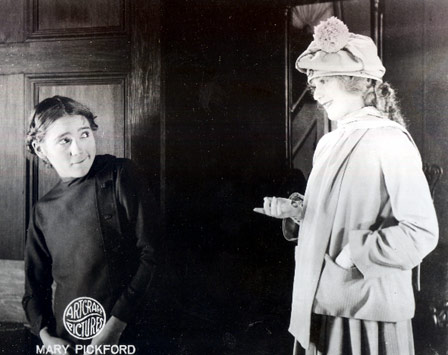
1918. I fall in love with Mary Pickford every time I see one of her films, and it’s difficult to remember that her hands were smooth and delicate, her body serenely curvaceous ten years before my grandfather was born. I cannot imagine her slacks torn, her belt broken, and yet watching her, how she loves, and how her heart breaks, I wonder how indebted I am to her for knowing the motions of love–is it she who taught me to slump in the corner or hold your hand to my chest or kiss the top of your ear and bury my face in your hair? Is it she who taught me that when the deus ex machina feels Aristotelian that’s just what we call love?

There was a three year age difference between us, me and the 15-year-old girl with whom I’d fallen madly in love. It was a very large gap at the time. To make things less awkward the first time we went out, I brought my best friend along and she brought some other girl, I don’t remember who. The moment she set eyes on my friend, she fell for him. Maybe they might have ended up together, but at first he loved me too much to hurt me like that, and later he ended up falling in love with some sexless knockout who nearly drove us all off a bridge in an attempt to spite his love. You can see photographs of the four of us looking painfully lovesick as we carried on in such torment for nearly three years.

Horatio Alger does not always prevail: the character Unity has an unfortunate face, a poverty of intellect, and a dearth of grace. But she’s played by the stunning Mary Pickford, who also plays Stella Maris herself. If the name Stella Maris indicates nothing but the character’s untainted purity, the choice seems a bit heavy-handed because the character is so predictable and empty; Unity, on the other hand, only lives up to her name by saving the day in the last five minutes of the film. It seems obvious that the drug-addict-wife needs to die, but it doesn’t seem entirely apparent why Unity has to commit suicide also. Stella Maris was born into misfortune, and upon rising from it becomes disenchanted with humanity. Unity is born into comparably bad circumstances, and only rises far enough to be a servant seemingly doomed to become an old maid. But the fact remains–underneath all that makeup is a very pretty Mary Pickford. So couldn’t the story just…you know, let her turn out happy? Of course not…The real turning point came when we went out on a date, the four of us, and then went back to her house to watch a movie or something–she asked me to get her a drink, and I walked to the kitchen before, looking back onto the sofa, I saw the two girls clinging to my best friend. It had been a set up! I was just a vehicle for propriety, and now they realized there was enough of him to go around all at once. I stormed out.

I find it easy to remove myself to the year of the film, to appreciate the maturation of photography, the use of the iris and the close-up and special effects (like two Mary Pickfords on screen at once, or a dog imagining another dog). After seeing the earliest Chaplin and Feuillade films it’s not difficult to be swept away simply by how the camera tracks away from the embracing characters in the closing shot, bumping along the road one can see appear just before the picture fades out; it’s not difficult to laugh or cry or lose your breath at the way Unity creeps through the shadows darkening all but a luminous stripe across her eyes, foreshadowing everything noir. These things become habit in later years, and if analogous to our own lives, we would, ideally, focus on intellectual pursuits; and so it seems natural that film should become more edifying as it grows less clunky. But not everything appreciates with time.

So, I left the house to cool off, take a walk. I removed my shoes because the air was so warm. And then my socks. And then my shirt. And my pants. And then through the populous suburban wonderland I marched a mile and a half down the center of the street in my underwear. I made it back to the house crawling, my feet swollen with blisters, bloody where I was lucky, and my best friend carried me to his car and drove me home, where they lanced my callous feet, again and again, blisters over blisters, a hundred times, and set me in an easy chair to dry. I was an eccentric, and he was a man, and that’s why they loved him and looked upon me as no more than a curiosity.

film: Newmeyer, Taylor: Safety Last! (1923)

Click picture for licensing details.

Drinking for seven hours, and suddenly the inclination to make fun like this, and it’s not unusual? Mentioning Kafka is rarely a smart idea. The only instance I can recall when it was okay was during a discussion over whether the Germans or the Czechs have more claim to him. Using the word Kafkaesque is never a smart idea. Ever. No, I take this all back: one has to earn the right to use the word in the same way Milton claimed to have earned the right to blank verse, something one earns through perseverance and bleeding fingers. Mostly I hear the word dribbling out of the mouths of people whose reading lists comprise little more than The Metamorphosis, On the Road, and maybe something by Bukowski. And would the word be better replaced by “nightmarish?” Yes, I think we could successfully eschew Kafka in our idle chatter and the sun might continue circling the earth.

The idea of “Kafkaesque” brings another detail to my mind, something that the term does not mean, something I’ve never heard anyone mention before. And the reason I call it forth now is because this slapstick romantic comedy uses a similar technique. I meant to discuss the importance of Harold Lloyd here, but this technique is more important to me:

A technique Kafka enjoyed using, at least in his short stories, was to begin by presenting a major problem, and instead of solving it, to instead solve an extremely minor and unrelated problem and present that as the dénouement. What this means, essentially, is that we’re dealing with a tragedy masquerading as a comedy. I just came up with this shit, my head hurts, but golly, thanks booze! This differs from my general theory of tragedy, in which what’s bad for the protagonist is generally good for some lollygagging third party, e.g., what’s bad for Hamlet is ultimately good for Denmark, differs because what’s good for the protagonist is bad for the protagonist. I cannot remember a specific example in Kafka, but I do recall observing this.

So, now we have Harold Lloyd, and here’s a brief synopsis: he moves to the city to make his fortune so his girlfriend can marry him. He gets a shit job, barely makes ends meet, and writes to her that he’s very wealthy. She finally comes out to see him and hilarity ensues as he repeatedly convinces her that he’s rich and important. And then he invents a zany scheme to become rich, very dangerous, and pulls it off so that he’ll win $1,000. Super. The film ends as he and his gal walk off arm in arm, presumably to get married the following day. Is he worse off than before? Yes. Because in the beginning:
• His girlfriend is an idiot.
• He landed his best friend a police record.
• He needs money to eat.

And by the end:

• He’s now also got a police record.
• He’s been lying to his girlfriend and has a lot of ‘splainin to do.
• He landed his best friend in jail.
• He alienated all his coworkers.
• He got hurt a whole bunch and now has to cover medical expenses.
• He broke a very large and expensive clock.
• He needs new clothes after his adventure.
• His girlfriend is still an idiot.
And where did all his problem-solving energy go? Easy. He spent the last half hour of the film trying to climb a tall building in a publicity stunt. Climbing the building becomes the main problem. But what about all the money he wins in doing so? I mean, really, $1000 is a lot of money, especially when we see that his rent is $14 per 3 weeks, and a meal is only 15 cents. Let’s do the arithmetic, shall we? Roughly, rent for two equals $880 per year, and food for two is around $365. That’s $1,245. What I mean is that he’s by no means wealthy, and will probably spend most of that money on fixing all the things he’s damaged. This should all be beside the point, and I’m writing now 14 hours later, with a hangover, because it’s early cinema doing comedy, and there’s something of an appeal to the down-and-out American that we love so well. Chaplin, for instance. We don’t consider it a tragedy to leave an American in rags, because we know that there’s always riches in the future. Horatio Alger’s bootblack Ragged Dick doesn’t begin in tragic circumstances like a chimney sweep of Blake’s, and there’s the great American dream, that the future always looks brighter. Recent polls show that for the first time in the history of the U.S., a majority of citizens believe that the nation’s best years have passed. And perhaps it’s that new mentality that forces our comedies to tie up all loose ends positively, why we’re not going to create a comic hero with the depth of Chaplin, Lloyd, or Keaton these days.

A last note: this film exploits the capabilities of the new medium immediately by tricking the viewer into believing the protagonist to be in jail as the film begins, about to be hung. When the camera changes position, we see that he’s only on a train platform and our eyes deceived us.

film: MacPherson: Borderline (1930)

Click picture for source

I was always judged very harshly by my appearance, which was something I never took much time to consider. It was around the time that my sister told me I’d taught her a valuable lesson, “that it doesn’t matter what other people think of you,” when I found myself with a host of new values, spending all my time shopping, grooming, tanning, fine-tuning the science of conversation, and, in a word, only caring about what others thought of me. Most people I went to school with are hard on the path to marriage now, and most seem to have really let themselves go, and me? I’ve grown more irresponsible and vain with every passing day, dedicated to nothing more than satiating my senses, living fantastic stories, and doing all I will to brutalize these deep breaths, my firebrands, my progeny, my animation. So, I suspect one of the key reasons I’ve been so enchanted by silent films lately is purely a sexual matter, whether it be Rudolph Valentino or Mary Pickford, so be quite sure that I’m not exaggerating when I claim to be in love. They entice my eyes. But H.D. (Hilda Doolittle), oh no, she does not. And yet she was Pound’s lover, and I find him to be enthrallingly handsome…so, clearly, her intellect could shine through that dangerously steep forehead and that brick of a jaw, a face I could not even bring myself to look at until I tried to convince myself she was actually a man, oh, the relief when she was finally murdered in this film. But why, oh why, did everyone else in the film have to be nearly so ugly as well? What I mean is I don’t care about art or entertainment: I care about pretty.

Director Kenneth MacPherson was a film theorist whose sole surviving film, Borderline, was considered by G. W. Pabst as “the only real avant-garde film,” remarkable considering this film was made in the same year as L’Age d’Or, and Le Sang d’un Poete, both the latter of which Henry Miller extolled for many years (while consistently leaving MacPherson’s work off his lists). This leads one to consider the logistics of distribution of art films in Europe at that time, given Borderline’s role in advancing the career of Paul Robeson and being what would today be considered an international effort—and also wonder why Cocteau and Bunuel’s work went unmentioned. While the use of montage may not add to the semblance of a narrative (indeed, what narrative might one draw from a film exploring the dictates of the unconscious?), it does not hinder the flow, adding something of a poetic rush to it, Eistenstein under restraint; this is furthered by the hand-held use of the camera, giving the film a naturalistic feel amongst the violent strobing. And this is where we find art, perhaps, couched somewhere in between the unnecessary and the useless.

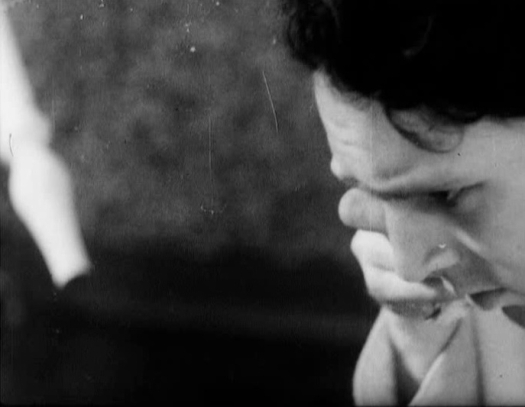
Maybe Pabst looked highly upon this film due to its use of excessive facial close-ups, something he made use of in his 1929 Pandora’s Box¬. Things taken for granted now were, for most of the history of drama, impossible, viz., subtle facial expressions, and this is one of the key elements that differs between pop and art films of the silent era; recall Dreyer’s Jeanne d’Arc and the way that facial close-ups are even now some of the rarer shots in contemporary film. One can see the progression through Feuillade or Chaplin as expressions slowly take the place of grandiose gestures…perhaps it’s only logical that it progressed so far as New Yorker fiction, in which plot was replaced by subtle character development, character development later replaced by inferences, and presently the inferences have been replaced by drivel. And you wonder why I drink myself onto the ceiling every night. Today, perhaps it’s the expression of the full body emphasized, or even the tone of voice, something early sound films did poorly, as a soft voice is analogous to a face’s subtle expression, and radio depended on flailing rather than lilting voices. I’ve written a bit about William Powell and how by 1932 he was a shining example of modern speech. Indeed, the majority of this film is carried by expressions, conscious hyperbole (as opposed to early film’s somewhat vaudevillian methods of acting), and frequent synecdoche as close-ups are used not only on faces but also on hands, arms, and torsos. Silent film may be likened to a deaf person whose other senses are thus heightened, and rarely does a film make use of all our senses. In this film one feels dirty from the spilled drinks and blood everywhere, tastes and smells the smoke and booze through its glorification on every character’s breath, hears the piano and phonograph so constantly seen, and lives the anxiety of the cutting, the lighting that switches from shot to shot, a film one lives, not views.

Borderline (okay, let’s try to be mature and academic) comprises extensive cuts, both in the physical film itself through the montage sequences, and in the domestic fight scene, during which H.D. wields a knife wildly and cuts her lover in a few places. And then there’s the demarcation of male and female, homo- and heterosexual, black and white, shadow and light, dream and reality, indoors and outdoors, hardwood doors and beaded curtains, water and alcohol, dancing and fighting, violence and joy; there are the fluids that will not remain in their vessels, whether blood that gushes, or drinks that spill, and, throughout all, the heretical concept, the heart of borderlines, pulses that nothing can remain static, nothing is born in its grave, that all will break free and finally converge.

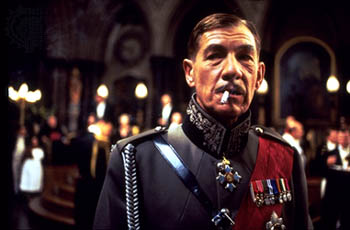
film: Loncraine: Richard III (1995)

When I first saw this I was instantly enthralled, the sounds of jazz, the colors and costumes, the explosions, the classiness exhumed from every cigarette butt. I’ve recommended the film to everyone I know. This time, however, I felt a bit offended by the extent of the slash and burn the writers made of original Shakespeare. I know it is common, but…this just felt overkill. Even small things, like the use of Tyrell as the chief murderer, rather than the director of a single set of murders, and the amount of time he spent on stage, ruthless and sadistic, working his way up the ranks–it leaves out the humanity of Clarence’s murderers, and thus steals from the audience a great scene of our anxiety, will he or will he not be murdered? His tongue is smooth, and he seems able to talk his way out of this! Or rather, he is just killed. Most strange is that Queen Margaret is removed from the film entirely–now, I find this most strange because I swear that I remember her being in it. As I read the play, I imagine the room all the characters are seated in, when Margaret comes from behind the curtains and shoots off her extensive rounds of curses. The room appeared on screen, all the characters were seated and waiting, just as in my imagination, and Margaret is nowhere to be seen. The scene in which the young Edward and his brother arrive, the film highlights Richard’s being slighted, and quite essentially weak, rather than make the quick battle of wits between child and murdering-king that, ultimately, injures the king also. This is the difference between Hollywood and Shakespeare–perhaps the reason why the two will never well mix. Well, perhaps Olivier’s version will prove more complete. I grew tired with this one, kill, kill, kill, and am sorry since I’ve so long remembered it fondly.

24 March 07.

poetry: Wordsworth: “An Evening Walk” (1793)

click picture for licensing infoWordsworth was doomed to be Wordsworth. Even at age 16 he was writing extensive descriptive poems of the places he’s seen, the every twig and feather seen on his walk. Of course, the words call to mind my own roving through his lake district, early in the morning, over misty hills, surrounded by sheep, and huddling under my coat in the soft rain, gaping at Grasmere. But it also calls to mind hours and what seemed like years sitting in coffeeshops in Amherst, swatting at flies, reading and re-reading passages aloud, drinking endless coffees in an attempt to stay awake through the dread burden of Wordsworth’s “Prelude.” Prelude to what? was my greatest fear…and “An Evening Walk” is the preparation, I hope, for “Prelude”–I know he valued this enough to have rewritten it and the editors placed it in an appendix. But such a slap in the face as the third or so poem in his Works…it makes me wonder if there is a god. Seriously, his writing is beautiful, and there is a way of reading it, somewhere between cognizance of meaning and hypnotic sleep, in which it makes sense to the soul. Professor Curtis and I would speak about the Prelude as if its reading was a progression through cancer, some weeks better than others. Oh, this week it made no sense to me, and there was nothing I could do, I worked through every line with a pickax and almost slit my wrists. This week, something happened, it all made sense, I found the necessary pace, and I trotted through the lines in a place nobody could touch me, I was inside the poem, I felt Wordsworth, I feel as if life will never end. This week, everything was shattered, I don’t understand why. Anything by Wordsworth makes me suspicious–I never know if I am reading the words of an old or a young man. And I don’t know how much it matters. If he was Whitman, I wouldn’t be concerned, but he is Wordsworth, and his soul seemed to rather shrink with age.

24 March 07

film: Taymore: Titus (1999)

click for licensing info

Granted, I have been suffering from chronic nausea for two months, and a film by WC Fields, a few weeks ago, had the same effect on me—but this is the first time that violence and gore has made me shiver nervously, nauseated me intensely. However, of all the film, that aspect was the least over-the-top, I mean, the violence and gore; and that’s saying quite a lot, given the possibilities. I like to attribute this to the director, Julie Taymore, having also directed The Lion King on Broadway.

The impression I get is that Taymore was given an immense budget and she determined to use every cent. The film is nearly three hours long. It has a cast of big names. The film is set sometimes in ancient Rome, sometimes the present, sometimes in a Peter Greenaway film, sometimes in a 1980’s sequel that takes place in New York, sometimes in a Fascist jazz-age bit. All the performers (except Anthony Hopkins, though that doesn’t excuse him) act as if they’re in a high school musical, the men are all excessively flamboyant, there are short scenes like interludes that perhaps are officially meant to give us perspective, but actually are there to show us more of the costume and prop department’s skills, and a bunch of nipples. I don’t know if the film is more like a three-ring circus or an informercial—but it’s near enough both.

Now, let’s see what the Amazon reviews say, whose critics give an average four stars:

“The play Titus Andronicus is Shakespeare’s first tragedy, and it shows. Though the dialog is top-notch, he hasn’t got a handle on the mechanisms of tragedy yet.”

People write as if Shakespeare sat down one day and decided to become Shakespeare. Was he not an apprentice once? And is there not a popular opinion that this was co-written with…who was it, Greene? Simply because this play is included in the canon today doesn’t mean it was or ever has been entirely agreed to have its place there. I disagree: if this play contains the elements of a “revenge drama,” the stalling revenge, the feigned madness, and the tragic revenge, Shakespeare writes an excessive revenge drama by necessitating all the characters needing revenge. All the characters need a good killing, they all need revenge.

“Shakespearean purists won’t like it.”

But isn’t it a bit funny that there’s such a dearth of films made for Shakespeare purists? I mean, aren’t they usually intended to guide the audience away from the verse, and towards the visuals? Aren’t I using the word “audience” loosely, thus?

“stylish, visually stunning, energetic”

–are euphemisms for what I call wasteful.

“If it is not enough, the movie has one of the greatest performances in Shakespeare’s tragedies I’ve seen and it is Harry J. Lennix as Aaron. Never have I seen an actor who was able to combine both, noble Othello and the embodiment of evil, Iago in one character so convincingly with such power.”

Were Aaron not black, I don’t know that this comparison would be made. But, if all Shakespeare’s black characters have an element of blackness to them, that must be brought out by the actors, well, then Lennix did an excellent job in acting black, I suppose, though I didn’t happen to notice. Why bring Othello into this? Iago, yes, is entirely evil. But Aaron? Just because he claims himself to be entirely evil, that in itself seems a bit questionable. First, he is a prudent lover of the empress; second, he loves his own child; third, there’s no evidence of his being evil, you know, digging up dead people and standing them at their friends doors, no evidence except that he claims it, but, what would one claim at the hands of death, after having been assured that one’s child will be granted life, and having nothing else to live for?

“And I love Shakespeare but, big, BUT, the verbage should be modernized”

—by which you mean to say, you don’t love Shakespeare at all, but you do love action-packed stories of murder and adventure. Julia Stiles in “O” proves that updating the “verbage” is a poor, poor idea.

“Yes, the play isn’t up to the literary standards of Hamlet, yes, it lacks the coherent picture of the characters’ motivations we find in King Lear, yes, there are loose ends and unexplained actions….There’s no indication of why the Goths would follow a renegade Roman in an attack against a city ruled by their own queen. Titus sends his grandson with a load of weapons to Chiron and Demetrius in Act IV, but there’s nothing more said about it. Queen Tamora visits Titus disguised as the goddess of Revenge for no apparent reason other than to hand over her two knuckleheaded sons to the Andronicii to be killed and baked into pies. When Titus appears dressed as Chef Boy-ar-dee at the start of the big knife fight in Act V, his costume is dismissed in two lines.”

And I don’t agree with any of these as being unexplained or loose ends, because:
1. The Goths follow Lucius apparently in the style of Coriolanus, as the play references.
2. Titus sends the weapons wrapped in verses to “wound beyond their feeling to the quick” as Aaron notes.
3. Tamora visits as part of a ploy to get all Her enemies in one room and enact revenge, or at least defuse the current military situation.
4. Titus appears dressed as a chef because the stage direction says so, which, if you feel is suspect since Shakespeare supposedly didn’t include stage direction himself, then also because Titus finishes the previous scene by saying “I’ll play the cook”–it seems quite appropriate to me.

You know what my problem with this whole thing is? Shakespeare is being used as a whore, dabbled over poor filmmaking as an excuse for legitimacy and artistic license. Where did all the money go?

6 April 07

Aristophanes: The Birds.

Click for source of picture.

It’s difficult to care–I haven’t any desire to write this because I just don’t care for the play at all–but that should be beside the point, shouldn’t it? I mean, because it’s a classic I’m not meant to enjoy it, right? I’m just meant to absorb it so I can include myself in the collective unconscious of the cultured, right? Right? Can’t I find something at all that attracts me, that holds me? Yes–there’s this one thing: the concept transliterated as polupragmosune. Arrowsmith, in the introduction to his translation, calls it the “spectacular restless energy” amongst the Greeks peculiar to Athenians, going on to say that “on the positive side, it connotes energy, enterprise, daring, ingenuity, originality, and curiosity; negatively it means restless instability, discontent with one’s lot, persistent and pointless busyness, meddling interference, and mischievous love of novelty.” The Birds traces the unavoidable nature of this quality as Pisthetairos seeks simplicity away from Athens, which results in his combination of Athens and Olympus, and his own apotheosis. And it’s this polupragmosune that worries me about my own nature–I don’t believe it’s the nature of all Americans, but I think it’s the nature projected upon the rest of the world. We find ourselves sympathizing with Athens rather than Sparta, when reading Plato and Plutarch has convinced me to reconsider democracy, and I worry about what a president of the EU could mean, what a United States of Europe could do to destroy history and culture, if it means another great superpower, if it means war. So is polupragmosune something like the artist’s lot? Or is it a political and social plague? Is it something I should be proud to possess, or does it clothe me in the most highly criticized qualities of Americans? This leads to one last question, then: can one possess these qualities to a less offensive extent than is dramatized by Aristophanes? Arrowsmith recognizes that these qualities were “born of life and aggressive hunger for larger life” in conjunction with Aristophanes’ illustration that the restlessness always results in one’s loss of happiness, one’s loss of dignity, peace, and honor. Victor Ehrenberg notes that polupragmosune has an opposite, but there is nothing in the middle, that only when one acts in extremes can “a conclusion be drawn as to his own nature.” And I am reminded of the epidemic of tedious melodrama we come across daily, the stories and obsessions, the hurt feelings and revenge tactics used to waste time, to convince ourselves that our own lives are worthwhile and fascinating, to convince ourselves that we are doing something in the meantime. Is this polupragmosune manifested in a modern democracy, where we all feel the need to build monuments at any cost?

“Polypragmosyne: A Study in Greek Politics, by Victor Ehrenberg”

http://links.jstor.org/sici?sici=0075-4269%281932%2952%3C205%3AT

Clair: Sous les toits de Paris (1930)

click picture for licensing info

All I’d seen of Rene Clair was his Entr’acte that–although I have no recollection of it, I do associate with Dadaism or some such thing. I trudged slowly towards home carrying this film in one hand, a bottle of wine in the other, knowing that I was to soon face the hell that is art. But, as sometimes happens, I fell in love instead. I’ve grown quite used to silent films, to the point that I prefer them to sound films, to focus on the visuals and only the visuals is something we rarely have the opportunity to experience anymore, for even in an art gallery we frame our paintings with the noises of the gallery itself, that acts as a frame for the frames, and our days frame the museums, so that somehow, even the sound of the cash register as we buy our tickets is the sound of Botticelli’s goddesses in repose. Clair works with sound, and yet his film is essentially a silent. He uses sound as punctuation, and one is forced to pay close attention to the sound when it is present, for he always offers an explanation. Background music always has an origin, although we rarely discover its origin until deep into the song, when the camera cuts to a view of a spinning record, or when the soundtrack itself begins repeating a single line, and a hand picks the needle up and begins the song again. A great fight scene occurs in which all we hear is the sounds of a train. And when the character Pola speaks, “non, non, non, non,” tiny breaths in response to silent whispers, that’s enough to fall in love with her, and with love, and with the fullness that is a soft voice.