Farewell, Frankenstein

This is why I’m terrified to apply to go back to school: because I sit around for 11 hours coming up with muck like this FOR FUN! I’m pretty sure that I’m not making the world a better place…

Intro – Early bio of PBS and MWS, their relationship up until then

Thesis – structure exists purely to send msg to audience = husband, and is largely ineffective, from all biographical notes. She couldn’t have done it otherwise…MS used the structure to draw attention to comparable Coleridge, and deduce details from there, that her husband should have noticed.

  1. Positive views of relationship/love/PBS as person (not poet/politician) –
    1. Relationship of Walton/Frankenstein vs MWS/PBS
    2. Relationship bw fiction-world/real-world vs Understanding/Fancy
    3. marriage
  2. Positive view of romanticism à romantic/poetic ideals, to real life/Coleridge
  3. Negatives, the narrative as criticism of PBS/Byron

Conclusion – effect on captain’s own life/PBS as regretful/apologetic/warning/MWS as apprehensive about PBS & Byron & children own ends, i.e., looking into future.

Poetry curse of poetry / F’s creation of monster / Mariner curse

HOW DO WE KNOW THE CHARACTERS HAVE ANALOGS

HOW DO WE READ BW THE NARRATIVE LINES?
analogous silent seas
ghost ship analogous (prostitute = love w/o love) to Frankenstein AND monster on sleds

impetus, ability to choose—kill the bird w/no reason, mont blanc of shelley, frankenstein doesn’t choose what to do in 1831—in 1818 he has the choice, MS criticizes him FOR CHOOSING, but in 1831 she doesn’t want to believe that he had a choice. SHe’s justifying his not paying attention to her when he was alive.

“unthinking” (radley, p58) / Impetus-ability to choose

Balance bw understanding and fancy

Interruptions of a world not imaginative (Radley 58) [while you’re writing poetry, there’s real shit going on] in ‘Mariner’ being what’s unimportang, what’s not ‘really real’—the world of understanding—whereas it’s the world of understanding that (Radley 131) needs to exist w/sublime.

Albatross (radley 61) “emblematic in a very complex way of man’s inhumanity to man, and of man’s rejection of love” (62, release from the silent sea, external isolation, external penance)

Misumi: The Tale of Zatoichi (1962)

I’ve been in a rut lately. We both have. I suspect it has something to do with that quarter-life crisis everyone’s going through. There’s so much potential for action that always seems to manifest itself in decisive inaction. Shopping for dishes, putting books in thematic order, wondering how two people can create such an enormous pile of laundry, beginning and ending each day with a bowl of cereal. We have no idea where to turn, how to take another step.

I practiced music for seven hours yesterday. Mostly bass, but some piano and guitar, cramming Led Zeppelin as fast as I can. And about six hours into it my fingers suddenly came alive in a way that they haven’t done in perhaps a decade now, with a speed I remember having as a teen, but lost when I stopped performing. My fingertips aren’t blistered either. But we have a show tomorrow night and I’m terrified to put in any more time practicing today, an hour and a half, really pushing myself with strength and speed exercises, so scared that I’ll wake up to stiff fingers. Monday afternoon and evening I spent 11 hours working on a paper with my cousin, a paper on the structure of Frankenstein. It doesn’t take long before I’m pacing around expounding on “Mont Blanc” versus “Ancient Mariner” and Coleridge’s “high imagination” as Mary Shelley’s enemy, on some balance between this and that and trying to find busywork for my cousin before he throws me out at 1am, promising to paraphrase the paper I wrote for him and to return all my library books. I would love to be a student or a professor or something in academics, because I know I can sit there writing papers and feeling like it’s a game of rummy cue.

And then I’m stuck wondering if I should do the dishes, finish this beer, read for fifteen more minutes, practice, or what? I finished up all my medications for this sinus infection today, but I screwed up the schedule of steroids, prednisone, and I think I’m paying for it, I can’t tell, my instinctive solution to anything and everything is to drink a Red Bull and see what happens. I’m seeing what happens.

Before I began watching samurai-sorts of films, I assumed, as I expect most people do, that samurai films are like any other action or martial-arts sort of movie. They’re not. And here’s why: because there’s no action. Newer films like Kill Bill are at times true to this by dispatching speedily the fights with the greatest buildup. So Zatoichi carries this martial minimalism to a degree that could probably only be surpassed by sleeping characters dying peacefully. It’s the tale of a blind swordsman. He’s not a samurai, so there’s none of that pesky baggage of masters, ex-masters, shame, etc. to get beyond. He’s just an oafish blind guy who stumbles around like Mr. Magoo, gets himself into silly situations, and then kills everyone. Oh, and he also a real heartbreaker. The point is, the swords are beside the point. The main character has no objectives, conflicts are resolved via invisible violence, and you’re stuck with 90 minutes of morally ambiguous character-development.

Neame: Hopscotch (1980)

I let Criterion select comedies for me. Well, I let them select anything for me. But their comedy selections are always perfect and end up being some of my favorite films…

but I can’t really come up with anything to say about this film except that it made me feel good. I don’t want to own it, but I could probably watch it again. How can my brain be so blank?

Well, there’s this: I’m sick, I’ve got some sort of nose and head thing, it’s infuriating. I’ve got a plate with bits of cheese on it beside me on the bed, and the dog is wandering in circles on the bed trying to not let me know that he’s wondering about the cheese plate–but I made a wall of Kleenex and books and a lambchop doll, so he’d be pretty conspicuous if he really went for it. And in the meantime, I went downstairs to get that cheese plate, and thought maybe I should have some nuts too, you know, for protein. So I went to get the nuts out, and it was ant city in there. I mean, they’ve been around lately, particularly today they keep making their way into bed with me, but we haven’t figured out where they come from. Now we know. They come from behind the dishwasher.

So I sat there with the vacuum cleaner, just massacring them, though you can see them wandering around inside, and finally we took some bug killy spray and squirted it in the crack behind and above the washer. The way I justify the ants coming to get the food is that I bought some food that I shouldn’t have; it’s not kosher, and I figured I’d just not eat it in the house or something, but that was what they found, a whole bunch of blueberry muffins; and the way I justify killing them is that in some ways it’s a matter of life and death. Will I die without the muffins? No…but if I let the ants take all my food and I could never eat any because the ants had taken it, then I’d die. It’s a matter of nuance, I suppose. And I hate things like that because, of course, I believe if you play nuance with life and death, God will play nuance with you too.

The only solace is that we don’t even know what life is. Certainly we can’t create an ant, but beyond that, we don’t even know if an ant counts as an individual or if an ant colony is actually the individual itself. In which case it’s like chopping off a little toe or something. That’ll grow back in about half an hour. Nuance.

And after killing hundreds of these things, I take my cheese plate and wander upstairs to try and kill off the infection inside me that’s also trying desperately to live. It all hankers after the biblical Jonah story, but not the whale part, rather, the part about the little tree dying and his being angry that it must die.

…and in Hopscotch nobody dies.

Phew, didn’t think I’d be able to make a connection after all!

Fitzgerald: This Side of Paradise (1920)

For not being one myself, I’ve had more than my fair share of run-ins with rich folk. The girl who gave me this book told me I had good breeding. I didn’t. Maybe somewhere in my blood is some toughness wrought by centuries in the Ukranian bloodlands, by warriors of sworn obeisance to William the Conqueror, but by 1920 the family war poor all around, violent and abusive tempers on both sides of the family, maybe some peasants, maybe doing what they could to lift their names out of the dust.

Let me quote the entire back of the book:

F’s first novel…was an immediate, spectacular success and established his literary reputation. Perhaps the definitive novel of the “Lost Generation,” it tells the story of Amory Blaine, a handsome, wealthy Princeton student who halfheartedly involves himself in literary cults, “liberal” student activities and a series of empty flirtations with young women. When he finally does fall truly in love, however, the young woman rejects him for another.

After serving in France during the war, Blaine returns to embark on a career in advertising. Still young, but already cynical and world-weary, he exemplifies the young men and women of the 20s, described by F as “a new generation grown up to find all Gods dead, all wars fought, all faiths in man shaken.”

I don’t know what idiot wrote this description of it, but it reminds me of what Caleb’s father once told me, that English departments suffer because literature is all taught as if it’s a vehicle for something–a theme, usually. I still don’t know what a “theme” is–I couldn’t even use the word in a sentence.

The distance between us and Fitzgerald is more or less than distance between Fitzgerald and Byron. And to me, the speed of change in that period is positively wonderful. The difference between the carefree prose of Coleridge (i.e., his autobiography), and the critical prose of Pater, and finally the novels of Fitzgerald is one merely of degrees of expressiveness, as all three always use the right word always always, Fitzgerald owns the language in a way that must have previously been unimaginable–Henry James spends half a chapter forcing a character off a train and into a hotel, building a man out of nothing. Fitzgerald does it within a few sentences, distilling a million people into this one, hateful boy, introducing us to a person we’d already known.

I suppose the question is whether or not the person existed already?

I think, yes. Byron and Shelley, for example. Rich kids fooling around because they know that ultimately they’ll face no real consequences. Byron’s dislike of Keats because he’s poor. Shelley, no different than all those rich uber-hip vegan dumpster-divers I once knew–you can eat out of the trash and eschew bathing all you please, but at the end of the day you’re really going to have to return to the trust fund. Tragedies are stories about rich kids who accidentally don’t pick themselves up in time.

I can’t remember that word…the one Baudelaire loves…yes, ennui, and there’s amusement and the constant waiting for it to present itself to you, other people, life, the dullness of old age and dying and how delicious bodily filth and venereal diseases are, the mid-atlantic accent, the knowledge that anything is possible, truly, anything, if you have money to throw at it–this i’ve seen, this i’ve experienced. Sadly, hatefully, it so often comes with the intelligence that has no choice but to happen if you attend the right schools. Perhaps I’m only bitter because more people that I’ve known than that I haven’t had discarded me once they realized that I haven’t l’argent to back up the number of books I’ve read.

The book more or less skips over the war, and whatever significance love holds for Amory Blaine seems trivial in his stylized treatment of it, I hardly remember his stint in advertising–but despite his world-weariness and cynicism, I don’t think he exemplifies the young of the 20s so much as he does the young rich, always.

Henry Miller is my favorite because he comes from my family’s world, from the streets of Brooklyn, from immigrants, and rises up to always use the right word. But he speaks as a poet. And he spends frivolously. And his 1920s are entirely different than Fitzgerald’s. His 1920s are a decade of subsistence within a lifetime of subsistence.

But this is where it all ended. Well, the second war, where the onslaught of the middle classes into the universities turned the rest of literary history into a portrait of the middle classes going to war and then to universities and then doing the day-to-day things we know like the back of our hands. And the right words stopped being used and everything’s postmodern or groovy or emo or hip and all of a sudden we find ourselves listening to the rich kids who are trying to write like the middle class kids and I cry and I cry and I cry and find myself sitting in doctors’ offices reading car-repair manuals instead of novels, and I don’t know what the right words are to say, I don’t know them except when I look at them in a dictionary.

I don’t know how Fitzgerald felt, but he felt enough to make fun of these people.

Aeschylus: The Oresteia

There’s nothing like giving oneself a facial to really get one thinking about the definition of justice. And like Plato, I’m not about to provide any answers.

Most people who spend any length of time around me know that I have my little fixations, usually on subjects that make everyone around me uncomfortable. So one of my primary objectives each day is to never expose my true feelings on this or that subject, but rather do my best to consider all sides…and usually that’s more elucidating anyway, as never in the history of mankind has someone changed his or her mind.

Facts are feelings.

When I was learning to drive, one of the things I was taught was “a million people can’t be wrong, so follow the indentations of their tires.” The follow-up question, of course, is “what if those million people were Nazis?”—not referring to the driving skills of Nazis, but the general rightness or wrongness of their beliefs or actions.

The answer is supposed to be “yes, a million Nazis were wrong.” And, so long as we’re counting, you can include pretty much everyone in Europe and England and the US and the Middle East, including the Jews who thought God would save them, including the Jews who considered themselves Nazis more than Jews. Everyone was to blame. The Americans and Brits were to blame for leaving France weaker in post-WWI victory than the Germans were in defeat, Churchill was to blame for obsessing over Britain’s retention of India and losing his voice nationally, the UK was to blame for not following Keynesian economics or rearming itself, the Church for striking deals with the Nazis and fascists, the US for its unchecked anti-Semitism and weak enforcement of the First Amendment.

And so we repeat, “never again.” Yet, if there’s one thing the 20th century has taught us, and the 21st century has affirmed, it’s that if you want to kill thousands, tens of thousands, hundreds of thousands, millions upon millions of people, then you can get away with it. You’ll be ignored until you’ve finished, and then you’ll be condemned, and then you’ll be protected and live to a ripe old age. The Serbs still think the genocide should count as a patriotic act, not a war crime. The Turks deny the Armenian genocide ever happened. And both these countries are still on the path to EU membership? The Russians love their Soviet leader, Putin, who doesn’t seem to be garnering support for re-election so much as permission to go back in time. In Darfur a collective “oops” led to everyone on both sides just pretending that, you know, their next door neighbors didn’t murder their extended families, etc. etc.

Never again! At the rate things are going, you’ll have your turn too!

And then the law gets in the way when it comes to more than 25% of Cambodians being killed during the Khmer Rouge regime…because, well, that can’t be defined as genocide since the killers and killed were indistinguishable from one another ethnically. So, was it right? Or at least okay? According to the current Cambodian government and the UN that supported/supports(?) the Khmer Rouge, yes, it’s okay.

Usually it all works like any business corporation: shareholders ride the ups and downs, and if anything goes horribly wrong, the people on top can’t be held personally responsible. The Nazis were responsible. The Khmer Rouge was responsible. The Ottoman Empire was responsible. And since these things don’t technically exist anymore, everyone’s off the hook.

Why did the Nazis become so popular? Because they didn’t just provide answers, they also provided solutions. They took a worthless, defeated, embarrassed country and turned it, briefly, into the most powerful nation on earth. Did the first war actually just end because everyone was exhausted? Historically, isn’t that what determines the course of wars, the relative ease of a government of securing loans? Or is it which monarch will allow civilian deaths to go on longest?

Didn’t ordinary Germans finally turn against their government and question why this war was happening in the first place? And then, after all this struggle, why, within shooting distance of Paris, were the Germans were somehow declared the losers? The Jews, of course. And economic and military strength grew quite quickly once anti-Jewish policies were in place. It doesn’t always work out that way. And it’d be a stretch to say any other genocide occurred in a modern, industrial country. It’s not that the whole country went mad, it’s that the country made decisions in its best interest that, likely, any country would do. I mean, consider all these African and Middle Eastern countries involved in civil wars related to the Arab Spring. Give these governments better infrastructure and less ineptitude, and that’d be all they’d need.

And so, we’re ultimately left with the problem that once in a while a few policymakers are condemned for their policies, but let off the hook for trying their best to do good under stressful circumstances. And their subordinates can all claim to be “just following orders” as a valid legal defense, the law of command responsibility. And that’s why it’s okay that 20-some American soldiers raped, tortured, mutilated, and murdered more than 500 unarmed civilians at My Lai. That’s more or less how the reports from Iraq go too.

And that’s where it gets so confusing for me. “How much justice can you afford?” is the correct question. If you have a lot of money, you’re in charge of whichever government you choose. US elections can legally be bought by foreign donors now—and just as sure as the Chamber of Commerce supports outsourcing American jobs overseas, they’re also willing to receive and distribute foreign money in favor of their chosen candidates.

And so we return to the awkwardly disconcerting ending of the Oresteia. Individuals should no longer take matters into their own hands, because we now have Justice. And according to Justice, if while hiding you saw your sister gang-raped and then have her hands and tongue cut off by some soldiers…well, a crime hasn’t been committed. And if you sought revenge, there’d be nobody to blame for what had happened. And so all over the world our neighbors were actors in horrific crimes against humanity—and they’ll never, ever be held accountable.

The both sides: one, that life is precious; the other, that if personal justice went unchecked, there’d be total chaos.

Mussolini’s entire “Doctrine of Fascism” reinforces this. The state is a living creature, endowed with the same rights liberals of the 19th and 18th centuries believed held by individuals, Mussolini said. The difference, he says, is that an individual only has those rights and freedoms by being part of the state. The first part sounds similar to the 2010 Citizens United decision by the Supreme Court. The second part sounds like the proposal to support a Republican purity test a.k.a “Resolution on Reagan’s Unity Principle for Support of Candidates.”

Fascism, ideally, involves people acting like bees, sacrificing themselves for the good of the hive. Where we are, rather, is more like an ant colony, everyone working toward the good of the hive, but inebriated with an individualistic will to live. We look at Pol Pot killing off his family, or Richard III’s ruthless murdering of his nephews, and condemn their heartlessness when they’d be more aptly described as doctrinaire. And the line blurs further when leaders call abortion-providers murderers, or call gays honest-to-goodness devils, inspiring their followers to kill doctors in Kansas and gays in Uganda. Doctrinaire, indeed. Following the law of command responsibility, rarely. So, how much justice can you afford?

I definitely, definitely had time to do a mud mask after all, dammit…and I still need to iron my pants for tomorrow.
Ke$ha – Frenzy

If you weren’t aware, I’ve put myself on a strict no-reading diet for nearly half a year now, and you can imagine that such a thing is terribly painful to me as I derive so much pleasure from sitting around discussing Bataille in coffee shops and trying to be the coolest person in the room. I’m not sure how kidding I am! But for certain, within these past six months is when I’ve finally started really growing to find students and professors fairly disgusting things–probably because I have a job. Anyway, that’s why I haven’t been writing about reading, and although I’ve continued to watch films, doing so has been entirely for the purpose of entertaining me during meals, and my strict no-reading diet is also a no-writing diet except for matters of business. So that’s been that. I have, however, been making quite an effort to listen to as much music as possible, and those songs that strike me I note, and have begun posting them on a different blog, which I’ve decided to move over here.

And I think I’ve finally torn down most of the walls I’d put up around music–I mean, yeah, pretty much everyone likes Britney’s “Toxic”–because while it’s a great pop song, it’s also a brilliant arrangement, so everyone is happy. But even people who say they like pop seem to choke at the mention of Justin Bieber. So I listened to his album. And “U Smile” is kinda one of my favorite songs now–I think it’s catchy and clever and pretty. But you want to know what’s pretty much my favorite song of all right now? This one. Words cannot describe how entirely perfect it is. Why it’s only a bonus track, who fucking knows, because I think it’s more solid than any other track on the album, even “Tik Tok”–seriously. Can you imagine if we took her cue moving forward, stripping arrangements down and forcing us to really focus on vocals like this? A lot of the past five years has been about really piling on the lushness, which I must admit I love, the lushness that’s difficult to tear apart because so much of it is built on delays and reverbs, infinite rooms–and what if you simply cut away just enough to leave an intriguing arrangement? I really can’t get enough of this song and I hope I never do.

The Old Country

It’s addicting to press onward, despite knowing that the end of the trail is never very far away, and that it ends in violence, mass graves, and, a little further back, if you’re lucky, a lack of last names. The new book, I think it’s called The Bloodlands is controversial because some people say there’s no comparison between the Holocaust and the rest of the mass slaughters across Eastern Europe. The thing is, for me, there is. If it wasn’t Hitler who killed my family by taking them in to the trenches, stripping them naked, and shooting them, then it was Stalin, and if it wasn’t Stalin, then it was the Cossacks, and if not the Cossacks, then Nicholas II or Alexander III.

Yet before the Cossacks, life was beautiful, they said, they’d iceskate in the winter. And then the Cossacks came and began lopping off the heads of Jews in the streets. And the Jews who hid under the floorboards, the Cossacks would stabs the floors with their swords to kill them.

Their parents told them Odessa. The naturalization papers, the ship’s passenger lists, and the WWI draft cards say Rotmistrovka, or Thormistrovka, or some variation. Over 400 km from Odessa. Perhaps that was the lie they had to tell, because the village seems to be more or less gone now. There was a Jewish population, I know this, there’s a picture of a rabbi from the 1800s I’m researching. And now, what I want to know, is what this Congregation Rachmistrivka in Brooklyn is all about. My family wasn’t living in Brooklyn–one of them worked in Brooklyn, but they lived in Manhattan.

At lunch with cousin Julia, it’s funny to hear about my grandfather as a little boy, hugging and kissing her because he’s so excited, about my great-grandfather as a very handsome man who she was so proud to walk next to when he’d visit, about how New York was a very antisemitic place, how any good that Roosevelt ever did was thanks to his wife, that his economic policies were poor, how Truman’s wife was an antisemitic bitch, how the German Jews were a bunch of arrogant Nazis, Nazis and Germans first, in denial of being Jewish, hating all the other Jews in New York for being non-German and unassimilated. Until afterwards, when they found out what happened to those that had stayed behind in Germany, about how Hitler had to teach the German Jews that they were Jewish, to remind them that they weren’t Germans after all, and the ones who’d moved to America were the last to find out. About how everything that was good about New York is gone now, that it used to be a place with thoughtful and intellectual people, that there was no place in the world like it, that now it’s just another city, the attitudes are gone, the people are gone, they could live without it now. When you’re born in 1919, that’s what you remember. You remember being a gorgeous model, you remember being sent a letter from President Hoover because of your intellectual brilliance, you remember living in the Village with the other artists and writers, about the early marriages that ended poorly after everyone in the family warned you they would, about sneaking onto the subway as a little girl, about how you once saw a photo of your father, who died on the day you were born.

Hitchcock: The Man Who Knew Too Much (1934)

There’s a technique surely everyone’s now familiar with in suspense or horror films: humor. Often the first part of the film is lighthearted, which serves to…well, you know, make it so that everyone in the audience is really primed to be emotionally demolished.

Hitchcock’s actors in the Man Who Knew Too Much included Peter Lorre, who worked with Brecht, and Nova Pilbeam, who  married Pen Tennyson, great-grandson of Alfred, Lord Tennyson, who took over the post of Poet Laureate from Wordsworth, who’d assumed it after Robert Southey, totally mocked by Lord Byron, and Tennyson’s descended from Edward III, of pseudo-Shakespeare fame, and Blake pseudo-fame. Hitchcock, who considered Bunuel the greatest director, Bunuel who worked with Dali, Hitchcock who was worshiped by Truffaut, Truffaut who called Night and Fog the greatest film ever made, which was made by Resnais, who thinks Nathalie is a sweetheart, and so do I, and tomorrow I really need to call her.

I mean, when you stop and think about it, that’s all so much more fascinating than the lies we’ve been told about the good intentions of George Washington.

Hitchcock remade this film in 1956, my comments here, and the film is fairly dense both structurally and in terms of character development. It’s a gorgeous example of the director knowing more about the characters than he lets on, and because there are no explanations, we’re left believing these people are real. Is it necessary? No. Does it make the film more forceful? Yes. But what other differences are there?

Well, to start with, I’ll remind you that this is a story about a child being kidnapped and how his parents go about saving him. The 1956 version has a weaker female lead whose strength is in her musical ability, weakness in her mental fortitude, and the film is just as much about the saving of a child as the saving of a marriage. The 1934 version has a couple with a delightfully sense of love and humor, a British version of Nick and Nora Charles, though The Thin Man‘s earliest European release date is from the same month as this film’s release! So much for Nick and Nora Charles being essentially American. The mother in this story also happens to be a sharpshooter who saves the day not by singing, but by sniping the baddie off the fucking roof. Yeah. Imagine Doris Day with a rifle.

It always gives me a little chill when Brits show anything that look like real emotions. Maybe that’s why I like Lily Allen.

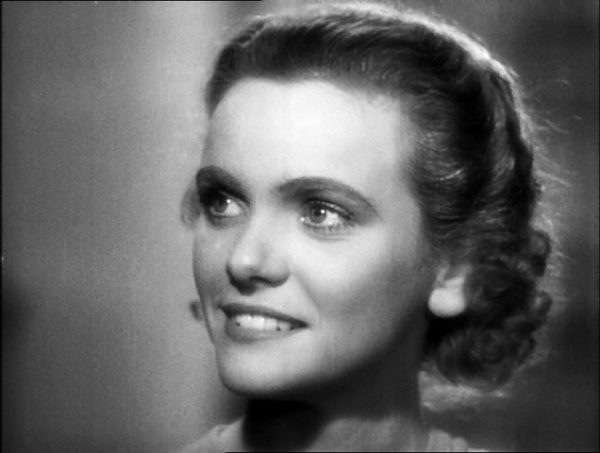
In the 1934 version the child is played by the 15 year old Nova Pilbeam, who’s made to seem much younger, but who, in actuality, was a total hottie, and one of the only starlets of that era with whom I still have a chance to, you know, get with. Even if she is 90. I’ve seen some pretty vibrant nonagenarians. If you have her email address, please let her know.

Compare her with the boy in the 1956 version. Both kids are talkative and walking calamities, but Nova Pilbeam is adorable and the boy is insufferable. I hate him. The kidnappers can have him, because I hate him from the very first scene. It’s also worth noting that Nova Pilbeam’s acting stands out as superb, especially considering the differences compared to other actors of the period. The final scene, when she’s a little hysterical/shell-shocked, is stunning–it’s unlike any sound I’ve ever heard uttered on film up until that point. And her pajamas, prisoners stripes, are a sickening addition for the wardrobe. I must add, though, that anything I watch from this period is with one eye toward the trenches of the Western Front, another eye toward Dunkirk, and that awful understanding that as this film was being made, even one of its stars had already fled Nazi Germany.

We only think time goes quickly because we have the capacity to suffer so horribly during short periods.

But a hundred summers ago we had no idea that the British Empire was about to collapse. King Edward died in May 1910, which means that the film Mary Poppins begins before that date (“it’s grand to be an Englishman in 1910 / King Edward’s on the throne, it is the age of men”) — Kaiser Wilhelm, his nephew, was at his funeral, and the family name was still Saxe-Coburg-Gotha. Wilhelm blamed the German disillusionment with the war, and subsequent collapse of the country, on the Jews, stating that they should be wiped out as a vermin.

“And if we spoke we’d never see her again. It’s her life against this fellow, Ropa’s. Why should we care if some foreign statesman we’ve never even heard of were assasinated?”
“Tell me, in June 1914, had you ever heard of a place called Sarajevo? Of course you hadn’t. I doubt if you’d even heard of the Archduke Ferdinand. But in month’s time, because a man you’d never heard of killed another man you’d never heard of in a place you’d never heard of, this country was at war.”

And there you have it. That’s how the world works. That’s logic that every single person in the audience would have understood. Our ancient history hadn’t been written yet. Perhaps it reminds you of today. A man we’ve never heard of is supposedly going to open a building whose purpose we don’t know, on a street none of us can name and certainly can’t find on a map. And the whole country is in an uproar because the Republicans see it as evidence that our president is a terrorist sympathizer. We’re all slaves, every single one of us. Stupid fucking slaves whose lives, to our leaders, are worth less than the ink on our birth certificates. But god, we know how to suffer. We know how to take a bee-sting and feel it for an eternity. So it’s easy to think you have all the time in the world, easy to think the Great War happened before the invention of consciousness. But it was just yesterday. I’ve met and touched a man who fought there. There’s so much more to life than the petty shit you find important.

And here’s some recommended reading on Hitchcock’s 1930s films as anti-German: http://www.filminfocus.com/article/hitchcock_at_war/print

and lyrics and footnotes to “The Writing of Tipperary” http://www.mysongbook.de/msb/songs/w/writingo.html