Hitchcock: The Man Who Knew Too Much (1956)

I haven’t any idea why both Doris Day and Jimmy Stewart hold such happy places in my heart–but they do. This is the sort of Hitchcock I enjoy most, when I’m not left feeling sick and paranoid. Well, right now I’m feeling sick because I’ve been drinking coffee all night and that’s a miserable thing for one to do. Beyond everything else, what I found striking in this film was his character development, which extended beyond the individuals and into their relationships with one another. I argue that Hitchcock takes the archetype of the hero/homecoming story for his model, but improves and modernizes it (don’t the two always go hand in hand?) by giving us two heroes whose ‘home’ is contentment in marriage; and I don’t mean that marriage is the goal, as in much of comedic Shakespeare, but rather more like in Austen, where characters battle each other and themselves in order to discover why a marriage would be happy.

Hitchcock throws us in some sense in media res by placing us at what proves to be the crucial moment in a troubled marriage. And then, rather than relying on flashbacks a la Telemachus to divulge the prehistory, the characters themselves drop hints. The first indicator in the film that this Hitchcock follows the archetype is that the film is neatly divided into two segments, both of which begin and end abruptly, and all hints are found within the first segment. A third segment is the one that occurs before the film, being the one only hinted at. The Morocco segment lays out all the problems: the marriage is in trouble, and the son is kidnapped. The kidnapping of the son arguably is a result of the failing marriage, and the London segment is dedicated to saving the son and fixing the marriage.

The first thing I noticed was that the son talks a lot. He’s obnoxious because he’s constantly commenting on everything his parents say, usually in a way that serves to lift the mood of the conversation though he acts as if he doesn’t know he’s being witty or funny. I’ve seen children act like this before–it’s how they desperately attempt to keep everyone happy. It’s how they try to prevent their parents from arguing.

1. Ben (Jimmy Stewart) says he’s called his wife ‘Jo’ for so long that he’s forgotten that she’s called anything else–her name is actually Josephine. Not only has he forgotten who she is, but he’s also given her a new name, which, as in the first chapters of Genesis, is a way of acquiring domination over anyone/anything.

2. They easily get caught up in tiffs. This is maintained throughout the Morocco segment and ends with the London segment, when they immediately begin working together seamlessly.

3. He’s fickle about what he feels strongly about, or else he tries to take up her cause with excess vigor. When he pushes aside her distrust of Louis Bernard, after she insists he finally becomes enraged with Bernard, to the point that even Jo tries to calm him down–because his emotions don’t make any sense. This is what made me begin taking notes, because it made me believe they’d had a fight in the past to which he was reacting.

4. She wants to have another baby. She brings this fact up entirely out of the blue. To us. But it’s a continuation of a series of conversations that take place in the pre-film segment that we don’t see.

5. They have monthly fights. They let us know this–and the ‘monthly’ bit threw me off because it inevitably implies that it’s her fault, but it’s not Ben who says it. She asks, ‘Ben, are we about to have our monthly fight?’ when, if it was related to her, he would be looking to her for the answer. At the same time, this happens to be the same day that she’s mentioned that she wants another baby. The conclusion I reach is that everyone should be praised for not blaming the fights on monthly lunacy, but rather they should be blamed on a monthly reminder of fertility.

6. ‘Six months ago you told me I took too many pills,’ says Jo. They measure time with their fights; but also, if she’d merely taken one aspirin too many and had a stomach ache, she wouldn’t have pinned it to a date like this. I’m going to call it a suicide attempt. Ben says ‘you know what happens when you get excited and nervous’–and she usually becomes hysterical (whose Greek root suggests the stereotype I mean), the hysteria ultimately being what saves the day.

7. Ben’s big plan is to offer the kidnappers ‘every penny I have’ to get back their son. He’s thinking in terms of his own money, not what they share. This would be meaningless except for the detail that she’s a world-famous singer who he’s convinced to give up her career and move to a backwards town in the midwest and be supported by him. In fact, their whole Europe/Morocco vacation is being funded by him and his work as a small-town doctor. They begin and carry on a joke for quite too long about which fixed body-part or delivered baby is responsible for, i.e., ‘I’m wearing Johnny Matthews’ appendix’ and ‘All the way home we’ll be riding on Herbie Taylor’s ulcers.’ Jo’s the one who comes up with this concept–and it’s the first time they’ve discussed it, as Jo says she’s ‘never thought of it that way’ before. Where is her money, as one would expect her to be worth significantly more than he is? Who knows.

So, these are the hints. And I think what it comes down to is likely this: they made a ‘deal’ that meant her retirement, their marriage, some children, and their total settling down. It wasn’t in that order, as she’d played London four years before the film’s action, and their son is older than that, but since then she’s settled down–and another child hasn’t come. And I think this is why they fight, because he hasn’t held up his end of the deal, and he’s holding her down because he feels inadequate when he compares their respective financial values.

In the end, it takes what he regards as her weaknesses (her hysterics, when she screams and thwarts the murder; her music career, when she uses it to both find their son and keep all the bad guys occupied) to save them all. And while this occurs, he’s given the opportunity to deliver their son to her by rescuing him from near-murder. If the son was the most important focus of the film, it would have ended with his rescue, the happy family back together. But it doesn’t. There’s an additional, slightly jarring, brief scene in which the happy family returns to the hotel room: they open the hotel room door, Jo’s uppity friends who used to work with her in showbiz are waiting there for them, and only one line is spoken, Ben saying, ‘I’m sorry we were gone so long, but we go and pick up Hank’ [sorry, but the screenplay transcript I’m using was made by a Russian (seriously), and I don’t have the energy to go back and see what the actual Jimmy Stewart quote was, so you’re just going to have to imagine Jimmy Stewart speaking in broken English]. I think his apology indicates that he’s accepted Jo more fully as a person–accepted her past in music, and may be willing to give her back her career (he never flaunts her career in the film–though she’s happy to mention it, he’d prefer to discuss himself), and who knows, maybe they’ll make some more babies.
My Job & Ellis Island

My Job & Ellis Island

Half my family can’t trace their history back more than a hundred years because when we entered the harbor our names were changed, in one case a simplification of the original name, in the second case to the name of the town whence we came. Many people take for granted the fact that even have family histories, though by the complete disinterest shown by my older relatives, perhaps I’m just wrong, as they don’t seem to care in the slightest about who came before them. So it’s up to me.

In the meantime, as I transfer old medical records from handwritten to digital, a lot of these people don’t seem to have any idea how to even write their own names. I don’t hold potential illiteracy or poor handwriting/memory/deteriorating bodies against Them except insofar as it makes my job more difficult, especially considering that a large number of these troublesome records likely represent deceased patients. And what do I do? I write their names however I see fit. And their addresses. Sometimes I discover a corrected spelling of the name when two patients have the same address. A lot of people aren’t sure if they have diabetes or not. A lot of people don’t know their zip codes. A lot don’t know how to spell the name of their cities. A lot don’t check either ‘male’ or ‘female.’ A lot aren’t sure of what year they were born, and significantly more don’t know how to properly express the full date of their birth–so they take creative liberty in doing so. And then, here I am, trying to transliterate all of this into what makes the most sense to the greatest number of people in the office. But, no doubt, I get it wrong often enough. And in a way, I’m just inventing people, addresses, and medical histories; I might as well work at Ellis Island; I might as well be Shakespeare.

Ballroom, week 9

After much discussion of theory, and extensive attempts at solo technique, it was time for me to dance with him again. I led poorly. Even leading a right box was difficult because I kept giving slight indications of a turn and well, just generally lacked confidence, kept ‘double lowering’ instead of following the 3Cs, and upon failing to transfer weight during a progressional just stopped, lost my cool, contemptuously muttered ‘fuck.’ We tried again. I was a bit pissed off. And when we finished he said ‘that’s the best you’ve done.’ Then, and today, it has come down to confidence, and especially to not overthinking–to rather being in the dance than figuring it all out on the floor. I suppose, like anything else, that’s what practice is for, reaching a point where it’s unnecessary to think about the components, to focus only on the whole.

My grandmother is horrified that my instructor is male.

‘This might be a silly question…but…do you dance with your teacher?’
‘Yes. Of course.’
‘And…your instructor is a man.’
‘Yes.’
‘And you dance with him?’ she chuckles.
‘He’s not bowing me over and kissing me. He’s my instructor.’
‘Yes, I know but…why didn’t you choose a woman?’
‘Because I spent a considerable amount of time looking for the most qualified instructor in the area. And furthermore, my first instructor, he moved, he began by telling me that it’s too bad more men don’t come to him for lessons since he himself is twenty-thousand times a better man than a woman. Doesn’t it make sense?’
‘Well, I don’t know. But…echem, if he pats you on the bottom I think you’d better begin looking for a new teacher.’
‘Yes, Grandmother.’

Concerning the Line of Dance: this is the direction couples follow as they dance. It hadn’t occurred to me that something like this existed since in films it’s never noticeable, but, essentially, the center of the floor should be regarded as having ‘double-yellow’ lines as roads do, and, as in driving in the US and Europe, couples move down the floor on the right side, counter-clockwise. One should move to the end of the room before turning, though people tend to congregate in the center; thus, it’s, if not easiest, then perhaps most enjoyable, to be as far to the perimeter of the floor as possible where one has space to navigate and not be crushed. So far as the Line of Dance goes, the flow is to maintained by a leader with a decent working vocabulary of figures, thus if the couple in front of you is moving down the LoD slowly or not at all, knowing what I know at this point, I’d respond by leading natural boxes or turns that always place me back into the same starting position until space opened up and I could use progressionals to continue down the LoD.

Concerning Sway: the body should be always moving as the figure progresses, there is no point at which one should be still to complete some footwork or rise and fall. This fluid motion assists in creating a proper sway to the music.

Concerning the knees: they must be kept bent lower than one would expect, and also must be as loose as rubber bands.

Concerning Posture: I sleep on my right side out of superstition, and he called me out on it because he noticed a tenseness around my right shoulder and a slight tendency to turn my hips towards the right, which leads my arms to push towards the right and communicates confusing signals.

Exercises:

1. Balls of one foot on a stair, the other foot hanging down. Drop first heel and then bring it up as high as possible.

2. Practice closing by pretending one foot has a high heel and the other a low heel.

3. Back, heels, head against the doorframe or wall and sliding out foot and then closing.

4. Practicing everything while holding a tray with cups of water on it, and I must not spill any.

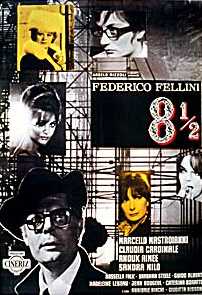
film: Fellini: 8 1/2 (1963)

8MezzoObviously, I’ve been putting writing about this film on hold for nearly two weeks, and I’m still not particularly eager to think about it, but it must be done, and so that’s that.

I suppose a good starting point is Kurt Vonnegut and Joseph Heller. The turning point for me, when I stopped judging books on their entertainment value and began considering them as ways to learn about life and myself, it took place over a month or so when I was 15. I’m sorry to say it involved precisely the books one would expect, but the truth is that around here we simply don’t have access to the names or titles necessary to an education–that is, if we’re not introduced to it, we don’t know what the right questions are. So when Lord of the Flies brought me to my knees, the people at the bookstore told me I should read Catcher, and from there I was assigned Catch-22 for school. I was more than 200 pages into it before I realized that it was supposed to be funny, and that all the things I hadn’t understood were because I was trying to read it as an entirely serious novel. And then I read 17 books by Kurt Vonnegut–usually I read about one per day. Vonnegut is a starting point, and I don’t think he’s much more than that. Mother Night remains my favorite work of his because it doesn’t fall into the trap that is the decades long retelling, retelling, retelling of his philosophy on life. At some point it occurred to me that I was simply reading the same book repeatedly. And the worst thing one can do is to look for what’s next by moving forward in time–it’s not difficult to move from Vonnegut to any number of postmodern authors, I don’t know, Pynchon or Barthelme, or simply look for the strange, Bataille or Beckett or Sartre, but at some point, one will be shown a door to the past, and refusing to open it is a terrible mistake. Doing otherwise, I think, leads to a hell of circles and confusion, of endings and false beginnings, and no concept of gravity or greatness. Luke and I once argued, his position being that the aesthetic or creative value of all works of art must be judged against both what came before and what came after them. This is wrong, wrong, wrong.

That was a tangent, and I was hoping it would lead nicely into what I wanted to discuss, but it didn’t, and so it’s very likely that I’m not really going to discuss anything at all, but I have to write until I make some sort of point. Oh, well, here’s the comparison between Fellini and Heller: the opening to 8 1/2 chilling. During a traffic jam in which no cars are moving, the cars are close enough together that they cannot open their doors. It’s summer, everyone is very hot. In one of the cars, smoke begins pouring out of the dashboard, but the man cannot open his door, nor can he break open his windows,  all while people in other cars look on not with fear, but as if at least something entertaining is occurring. And then he dies. The face of the man is never shown, but the hat is the same hat worn by the protagonist, so things begin making sense. What’s difficult is that nobody tells you that this film contains many comic elements–what’s also difficult is that I don’t know how it gained such wide success when it seems to address a problem faced by a small minority of people: artists: writer’s block. I’m led to wonder if perhaps everyone else simply has to deal with life-block, since satisfaction in life seems best attained through creativity of one sort or another, whether that means painting or fucking. So, life-block.

Guido’s ‘dead father complains about the size of his tomb’ (‘8 1/2.’ John C. Stubbs. Journal of Aesthetic Education © 1975 University of Illinois Press. p97), there’s a ‘Mack Sennett’ chase scene on the beach, ‘Gloria’s phony intellectualism, Guido’s cowboylike flick of his hat in the harem sequence, Jacqueline Bonbon’s dance, and the hanging of the pessimistic critic, to name only a few examples.’

But what I think I got wrong is Fellini’s use of comic elements–rather, they happen to be comic caricatures amongst a great number of varied caricatures. Here:

1. The episodic nature of the film.

2. The ugly faces.

3. Lavishness.

4. Comic treatment of dreams/fantasies

5. Grotesques of the mundane

6. Characters’ own grandeur.

Briefly, Fellini got his start as an artist of caricatures, line drawings; he went on to study comedy and become a comedy/sitcom writer, and only then went on to directing. But I think his interest in caricatures strongly characterizes his treatment of nearly every subject he explores in this film.

1. The episodic nature of the film: Fellini summed up the film as one ‘”in which parts of the past and imaginary events are superimposed upon the present“‘ (ibid. p102). And while this is something that undoubtedly occurs at all points in our lives, almost constantly, it’s not something usually addressed nor dissected. In this case, it is, all three seamlessly given equal attention that, through the unnecessary weight is nothing short of caricature.

2. Ugly faces: when we watched the first half of Juliet of the Spirits, I was crushed to be so disgusted by a film whose soundtrack I’d so long loved. Indeed, one of the difficulties for me watching Fellini’s films are that I know the music of Nino Rota pretty damn well, so that I already have associations with each song, they are not connected to the films. But, to the point: he not only chooses ugly and obese people, he gives them many close-ups. John Waters also chooses ugly and obese people, but he does not treat them in the same way because he rather abuses them while Fellini lets them just exist so that he might study them.

3. Lavishness: in Juliet this is obvious because of the colors, so bright and offensive I can barely breathe. They’re somewhat unnatural, which is also the nature of technicolor (whose day had already come and gone, which makes me think it likely he chose technicolor precisely for this reason), but there are enough examples of technicolor subtlety that his decisions are another example of, indeed, caricature.

4. Comic treatment of dreams/fantasies: comic because it’s the sort of things we think about: while being criticized many people may imagine the death of the critic. In this film the fantasies are carried out, and then swept away just as quickly. The death of the critic is very, very funny, as a result. Guido’s own fantasized death is less funny, as in his shame he crawls beneath a table and shoots himself during a press conference. But it makes us chuckle because it’s also true. Perhaps dreams and fantasies are inherently caricatures because of the depth of focus we give them as they consume us, but, regardless, treatment of them in a film is uncommon, and thus…

5. Grotesques of the mundane: In the meantime, everything commonplace in the film becomes outlandishly grotesque, silence is softer, the elderly older, parties more frantic, time moving faster. Scenes occur in places that seem unreal yet familiar.

6. Characters’ own grandeur: the spaceship launch pad that has no known purpose, but will be used somehow, the columns, the sizes of all buildings and the extent to which Guido carries everything is simply beyond what’s necessary.

Okay, I’m completely done with this.

Ballroom, week 8

I never mentioned dance shoes to my instructor before–I figured that if I waited long enough, if he came to believe in me, he’d ask me to go buy some. Today he asked. Hooray! So I went to go buy some, it all seemed pretty straightforward, and they didn’t have any like the ones he described–character shoes and ballroom shoes both had a steel bar through the bottoms so that they wouldn’t be flexible. But jazz shoes, that have split soles, are like little rubber socks. I didn’t want rubber bottoms, and she said leather would be too slippery, but that suede would allow me to slide without slipping, which is what my instructor told me was something I should look for, though he said leather. So I didn’t buy any shoes…though I nearly bought all of them. In any case, I don’t have anywhere good to practice. The kitchen is too small now, so I’ve been doing it in socks in a carpeted room or in shoes outside. It’s all rather silly.

Concerning the Left Box: I don’t know why it’s called that since it goes to the right, though it commences on the left foot.

Concerning the 3-Cs: this is the term to remember the Rise and Fall pattern when waltzing. The term stands for Commence-Continue-Continue. That is, one begins with bent knees, commences the rising action on beat 1, continues it on 2, continues it on 3. On the + of 3 the falling action begins, which would be perceived as a ‘drop’ (an indelicate term, apparently) if the entire falling action took place between the + of 3 and beat 1; rather, the lowering action begins on the +, which is where the knees are being lowered, the weight transferred to one foot, and CBM takes place if necessary. It’s in the next step, on beat 1, that the falling action concludes and rising action begins.

Concerning Rise: Keep in mind that the body will try to compensate for beginning with one’s knees too high by ‘double-lowering’ on beat 2, in anticipation of the rise on beat 3. The proper way to navigate this dilemma is, of course, to begin with one’s knees bent lower, and to Think about it as if one begins low, continues low, and then rises on beat 3. The body will take care of the rest, that is the commencement and continuation on the first two beats, naturally, from what I can tell.

Concerning Fall: In the Left Box, on the + of 3 (where the leader steps backwards on R), the left knee should be bent low enough that it covers the foot. This places one low enough to commence rising on 4. Rise and Fall should additionally be found within the pulse of the music, which will dictate the flow of movement.

Concerning leading a reverse step: This is led by not giving any indication of moving forward but actually moving one’s body backwards.

Concerning Progressives: So called because they assist one in ‘progressing’ down the floor. I’ve learned two reasons why not to go with a dance school chains, the first being that they teach patterns rather than method so that one only knows what to do when dancing with other students of the school. The second reason, then, is that it takes more than patterns to dance well socially since as a leader one must know what the next figure will be at least before closing the previous one–this is because rooms have different shapes and obstacles (such as columns) and a varying number of people who may or may not know what they’re doing.

So I totally bought some shoes. I don’t know if they’re what I was supposed to buy, but the bottoms are suede, and they don’t look like leather socks (which is what jazz shoes seem to me), and they’re special because I’m not allowed to wear them outside or else I’ll ruin them instantly. They’re so much fun, though, I’m very pleased!

Ballroom, week 7

I’m doing anything I can to avoid having to write about Fellini’s 8 1/2. So:

I just spent ten minutes balancing on my toes. Also, I had my knees bent and kept my heels as high as I possibly could, which had to be at least taller than a phone book, I’ve been told. I wish I knew where I’d read this, it may be from Plato, about all beings having unique hierarchies upon which each can be placed, the pinnacle being one’s exercising his or her existence to the fullest; and without getting into my own cosmology I’ll just leave things there. I say ‘unique’ because I’m certain that one’s circumstances, even if likely to be excruciatingly similar to a billion others’, are necessarily singular…which doesn’t make you special. A domesticated dog, for example, reaches its pinnacle by running with its tongue hanging out, eating shit (followed by grass), and unabashedly masturbating with the assistance of everything in the room. I suppose, when put this way, a dog doesn’t sound much different than a person; but dogs have recently been shown to have the ‘intelligence’ of a 2.5 year old child, and a much greater ‘social intelligence.’ And what’s the heights of humanity? Childhood is a cruel thing because it robs us of the time we need most. I don’t know the answer. But in my cosmology, of which I promised to spare you, there’s a reason we have bodies, and a reason we have time, and I know why we have illness, and I know why we have death, and I know why we have suffering. So I know why I must dance now. It’s not the only physical thing I’ve immersed myself in, certainly…

What I was trying to get around to saying is that posture is a funny thing, because we’ve evolved to a point where a certain posture is best for us. So, because I hassle my instructor rather than allowing him to move forward in our lessons, hassle him to teach me about every last movement, concept, theory, history, concerning every step, we haven’t made it beyond natural turns in waltz. That’s fine with me, because I still haven’t quite found my balance this week. But this is the first week that I’ve begun to find myself quite connected to the dance–there’s so much to think about, and when I lift my heels and bend my knees, the position I would be in briefly as I close, where I’m supposed to use CBM as I transfer the weight to my right foot, I can feel the muscles down my legs tense, and my abs as well, and about 7 and a half minutes into it I was shaking, but in the mirror my posture was Perfect, and I hadn’t had to consciously align my spine. And I don’t mean to say that evolution began with a waltz, but it is rather wonderful that dancing involves physical health.

Something I’ve found most fascinating is how walking takes place. In those videos of baby giraffes just falling out of their mothers and immediately standing up and wobbling off somewhere, and giraffes, from what I can tell, have little more than popsicle sticks for legs. We have feet, and we have ankles. And we don’t tend to give them as much attention as we should. I mean, beyond pedicures. Because if you end up with diabetes, a hangnail may lead to your whole leg being amputated. Meanwhile, there’s a transfer of weight from the back of one foot slowly to the front, which is supposed be at the ball of the stationary foot when the moving foot has passed the stationary one. Really? Is that how it happens, and then with the one foot touching down at the heel, the other foot is brushing the floor with its toes? That’s what walking is?

Well, lucky you, that melatonin just kicked in.

###
Definitions of Technical Terms

Alignment. This word has several meanings in dancing. It may refer to the position of the feet in a forward or backward step, when the feet should be perfectly in line, turned neither in nor out, and with the inside edge of each foot touching an imaginary line drawn through the middle of the body. It is also used to refer to the directional line of some part of a figure. Its technical meaning for examination work is described on page 26.

Amalgamation. A combination of two or more figures. See further explanation below.

Balance. The correct distribution of the weight of the body when dancing.

Basic Figure. A figure that is considered to form a part of the basis of a particular dance.

Brush. When the moving foot is being taken from one open position to another open position, the word Brush is used to indicate that this foot must first close up to the foot supporting the weight of the body, but without the weight being changed.

Contrary Body Movement. The action of turning the opposite hip and shoulder towards the direction of the moving leg, and is used to commence all turning movements. . . . In many cases, the term “Body Swing” would probably convey this turning action more clearly, for it should be noted at once that an excess of CBM will produce a dance that is more ugly and unbalanced than one entirely devoid of it.

Figure. A completed set of steps. See further explanation below.

Footwork. Conveys which part of the foot is in contact with the floor on each step. These are the parts conveyed as, for example in the case of a Reverse Turn (Waltz)–Lady: 1. Toe, Heel. 2. Toe. 3. Toe, Heel. 4. Heel, Toe. 5. Toe. 6. Toe, Heel.  “…although it is to be regretted that the new method of describing Footwork hardly gives a clear or true picture of the subtle uses of the ball of the foot as well as the toes.”

Natural Turn. A turn to the R.

Partner in Line, Partner Square, Square to Partner. Terms used to indicate that the couple are standing in the normal dance position, i.e. facing each other and with the man’s and lady’s feet approximately opposite each other.

Poise. The position of the body in relation to the feet.

Reverse Turn. A turn to the L.

Rise and Fall.

Step. This usually refers to one movement of the foot, although from a “time value” point of view this is incorrect. In the case of a walk forward or backward, for instance, the time value of the step is not completed until the moving foot is drawn up to the foot supporting the weight, ready to commence another step. Thus, when instructed to rise at the end of a step the dancer should not commence to rise until the moving foot is passing the foot supporting the weight of the body. The following analogy provides an easy method of remembering the meaning of the terms “step,” “figure,” and “amalgamation.” Think of a step as a “syllable,” a figure as a “word,” and an amalgamation as a “sentence.” A complete dance could be compared to a paragraph.

Swivel. A turn on the ball of one foot.

Tempo. This indicates the speed of the music. The approved speeds for standard dances are– Waltz: 31 bars/min. Foxtrot: 30 bars/min. Quickstep: 50 bars/min. Tango: 33 bars/min.

Time: the number of beats in each bar of music.

Variation. A varied and more advanced figure, additional to the basic figure.

my favorite poem ever: “Mom and Me”

Update: the author of this poem is unknown, and it’s definitely not my coworker’s five-year-old son. 

When I worked for a very large private company, I would sometimes use somebody else’s cubicle when she was out of town, and she had this poem pinned on the wall, written by her 5 year old son. And I’d read it, and reread it, I’ve read it a thousand times, probably. And I loved it so much that before leaving the company I sneaked in to copy it down. So…here it is…my favorite poem ever.

“Mom and Me”

Best friends forever
Mom and me.
Picking flowers and
climbing trees.
A shoulder to cry on
secrets to share.
Warm hearts and
Hands that really
care.

I mean, honestly, I can see why I loved it so much, and still do. It follows definite form until the end when everything breaks down in frightening exasperation, in which the poet displays stunning foresight, showing to his mother that yes, their relationship will fall apart as they now know it. Certainly, some things will never change, the flowers and trees, that is, their external environment, the things beyond our control, we will always have them, the poet tells his mother. By “a shoulder to cry on / secrets to share,” the poet explains that their past together can never be revoked, that indeed, he was once held by her as an infant and cried on her shoulder, and only they share the secrets involved between them during his gestation, birth, and breastfeeding. But it’s the final lines that break the pattern of two iambs (he isn’t strict with his syllables, but very confident with the rise and fall, the pulse of the meter) with a feminine ending that draws us to the following line–to be sure, imaginary lines of iambic tetrameter split mid-iamb to divide the imaginary lines in the creation of actual lines; the final lines:

Warm hearts and
Hands that really
care.

x / x
/ x / x
/

The breakdown serving a twofold purpose: not only does it portend the split that will pull them apart both emotionally (hearts) and physically (hands), it alerts us to the broken iambs that begin on line 1, and argues that to some degree this split in their relationship has existed since the very beginning.

So what exactly is this poem saying? I believe it illustrates the falseness in language of love, that the truth in a relationship hides under two layers, firstly, one of words, secondly, one of real actions, while the actuality is that all persons are ultimately alone in their experience of life, and that nothing, not even complete subsistence off another person, can bring us any closer to the ideals of love. Right, so…happy mother’s day.

Fixing My Car (part 2)

(continued from here)

CHANGING THE OIL

Is messy. Sarah recently criticized me by saying she’d never heard of changing oil being messy. I’ve heard it only described with two words: easy. messy. It’s messy. But that’s not bad.

1. Josh was determined to have us do it in his own driveway. But we couldn’t jack the car up in a way to get it onto some stilts to hold it up, and because I couldn’t convince him that it was a good idea to drive half the car onto the railroad tracks so that it’d be naturally lifted off the ground, and he swore to me that I’d never be able to lie on my back on a skateboard and get underneath it, I was doomed to do it like it was the first oil change ever.

At Michael’s we just lifted the car and put on aprons. It didn’t feel nearly as ‘Happy Days’ but it was faster, easier, cleaner.

2. An oil change involves emptying the oil from the car, changing the oil filter, and filling the car back up with oil. And if you take it to a shop they’ll probably check the air filter and tell you it’s dirty and ask if you want to replace that too. Both times I went shopping for this stuff at Wal-Mart. Michael used to buy special oil for his truck, very expensive stuff, from the repair shop, until he went into the back of the shop and found out it was actually cheap stuff they were marking up. So, to Wal-Mart where you don’t have to know much more than than the make and model and year of car, type it into their dirty little computers, and it tells you which filters to buy. As for oil, I chose W5-30 (I can remember this because W is the first letter of my sister’s name, who is 5 years younger than I am, and on my 30th birthday I’m going to cry. I have no idea what it all means, though.) And I just chose something that was in the middle of the road, $15 or so for 5 quarts, also choosing something claiming it’s better for vehicles with over 75k miles.

3. So, under there you’ll find a bolt that you can just ratchet loose, and then position yourself to pull it out and not get hit by the stream of dirty black oil that’ll burst out. Regardless, we used a specialized container for catching the oil with a proper filter so you can drop the bolt (or oil filter later) without losing it in the oil. At Josh’s it was still late April and I’d only driven my car a few miles in the past day, so the oil was only warm. And yes, as soon as I pulled out the bolt it came pouring down my arm, but it was mostly caught in the container.

At Michael’s my car had been running all day and it was August. Michael stood beside me with rags to catch any oil that might want to run onto my designer clothes, but in the meantime, as soon as I got the bolt unscrewed I had to scream a lot of bad words because the oil was really, really, hot, like, hot enough to pour on an enemy who’s scaling your wall, or on someone who’s been accused of an act of terrorism without any evidence whatsoever to help them through his writer’s block.

4. After it’s all dripped out use a rag to mop it up from anywhere on the car it’s gone running. I think this is to distinguish oil that we’ve allowed to spill there from oil that may leak in the future. So, now tighten the bolt back in. Really tight.

5. Now, find the oil filter and unscrew it and drop it into the oil-catching container with its top side down so the oil comes out of it. Unscrewing it is very difficult, and there are special tools made for unscrewing it. I’ve seen two different sorts of these tools. And neither worked. So your best bet is to just find somebody who’s very strong to do it for you. And even these strong people will have trouble doing it, as the strong people I found were 1) an eagle scout, and 2) a marine.

6. To prepare the new oil filter you pour a bit of new oil around the moat on its top, to, if I remember correctly, help make a…I dunno, suction or air-tightness to it once it’s screwed in. And then screw it in tight. But maybe not so tight that you’ll need a marine to unscrew it for you next time. I don’t know.

7. You don’t want to pour in too much or too little oil. So I called Toyota to find out how much is enough. My brother had estimated correctly when he said I should pour in a little more than 4 quarts, which includes the bit that I put into the filter itself.  This leaves one quart to carry around in my trunk in case I need more oil.

8. Now, check the oil with the dipstick, as usual. And after driving home, check it again, just to make sure nothing’s leaking.

9. As for the air filter, you find its compartment lid, and it’s opened by releasing some obvious latches. Pay attention to how the air filter looks when it’s in there, which side is which, etc. And then just prepare the new one to look precisely the same. Pull the old one out, and if it’s dirty, swap it with the new one. Make sure it clicks in satisfyingly. Put the lid on.

10. Hooray. You just saved like…$10 and missed out on a shop vacuuming your car and making sure it’s in decent shape.

CHANGING THE ACCESSORY/SERPENTINE BELT

1. Now, this motherfucker was drying and cracking. It was going to cost nearly $300 to have replaced. Replacing it involves buying a new one for $20, yanking off the old one and putting the new one on. While fixing the A/C we had to take it off entirely. Now, I didn’t actually put it on myself, but I watched, and I know the details. 1ZZ-FEengine

2. Pull off the old one. Now, we had an easy time pulling it off because we’d removed the compressor and so the thing just fell off. But in case you’re not in the middle of gutting your car, there’s something that looks like a bolt that, in this diagram (which may not be a diagram for a Corolla, since it came from a Spyder website but has so far worked), is called a ‘tension relief bolt’–and is pretty neato.

3. You turn the tension relief bolt, which is attached to the Tension Spring, which as the diagram shows…relieves the belt’s tension. Righty tighty lefty loosey does not apply here because it’s on a spring that will bring back the tension when you let go.  So you relieve the tension and dilly dally the old belt off each of the wheels it’s wrapped around. Notice that one side is smooth and the other side has grooves in it. The side with the grooves in it will be wrapping around the wheels with grooves in them, being, as I recall, the larger wheels, while the center smaller wheels are smooth and when wrapping the belt around them you’ll expose its grooved side and wrap its smooth side.

4. Which is what you’ll do now, which you won’t be able to do unless the tension bolt is turned so that it can make its way around everything.

5. Hooray. You’ve just saved $280.

Fixing My Car (part 1)

Problem #1: A friend of mine backed into my car and created a huge dent in the front bumper. Estimate: $600+ Fuck that.

Problem #2: I backed into a truck while babysitting. The kids were shocked, and I swore I’d get them dessert if they never told anyone it’d happened. They ate their desserts and told everyone. Estimate: $600+ Fuck that.

Problem #3: The A/C broke three years ago. The first place charged me over $100 (Canterbury Texaco, whose owner frequently stars in the comic strip Pluggers, seriously) to fix it. It wasn’t fixed, but they insisted it was as good as new. The second place (Toyota of Greenfield) charged nearly as much just to look at it and insist that it would cost them $900 more to fix it. They said that the A/C clutch was missing, that it couldn’t just fall out, and that they had no idea how the hell it could have disappeared. Back at Canterbury Texaco, when I asked if perhaps they might have forgotten to put it back in they angrily told me that it’s impossible to forget to put in a clutch, that the belt is attached to it and the whole car wouldn’t work if they’d forgotten it. Who am I to argue with anyone larger than me? So, that was that. Fuck that.

Problem #4: Accessory belt getting worn and cracked. Estimate: $200+ fuck that.

Problem #5: Changing the oil. Estimate: $40 fuck that.

Problem #6: The cops have pulled me over three times for a missing headlight. And my tires need to be rotated. Estimate: 150 years in prison. fuck that.

Total cost estimates: $2340 and 150 years in prison.

Problem #6: This is the one I tackled first. My roommates all promised to help me, but none of them would. I finally gathered all my courage and bought the headlight.

CHANGING A HEADLIGHT
1. Aren’t I lucky to have the hands of a ballerina?
2. Figure out which of the headlights is missing. This is the hard part, because I still have a difficult time figuring out which knob controls which string on a guitar. But eventually I did it. Now, it’s facing downwards, I mean, the wires and plasticy bits. So I rotated them in whichever direction worked, and with lots of effort, pulled the fixture out. Hooray!
3. Taking this bulb off the fixture involves pulling up a little clip and yanking hard, and you can touch it any which way you want, I suppose, since it’s just going to be disposed of (properly–…of course).
4. Putting the new bulb into the fixture is more complicated because you can’t actually TOUCH the bulb itself, for god knows what reason, but that’s just how it is. And then you push it in, underneath the clip, and then back in the hole it goes and you twist the fixture back to how it was when you found it. And now, now the police aren’t going to stop you every night on your way home from the bars. Phew.

ROTATING THE TIRES
1. If you want to know what to get me for my birthday, get me a tire iron that’s in the shape of a cross, well, a Swiss cross, whatever that’s called. Because my pupsik little tire iron is useless when paired with my pupsik little arms. And the hubcaps are difficult to get off because they’re plastic and feel like they’re going to crack when I begin prying them off. So the best way is to just use both hands and stick out my arse and waggle it a whole lot until they just come off and I fall over.

2. The lug nuts are easy to get off with a decent tire iron. But the big catch is where the car is…I mean, in relation to the earth. Even with the parking brake on and the thing in first gear, two of the tires still roll easily, and the other two roll enough to make it impossible to get the fucking lug nuts off. This means that the car has to be touching the ground when you’re loosening them. And then it can be jacked up. So…here’s the Michael’s lesson on jacking up a car:

3. On the back side, the lift’s arms have to be…well, shit, I can’t remember. Maybe it’s the front side that has the ‘nubs’–and on the nubbiest parts of the nubs, that’s where the front arms go. And on the back, they’ve gotta go near the wheels, actually, in a spot that seems pretty dangerous. And then up the car goes by pushing the green button. And once it’s off the ground a little bit, you grab the car and shake it like it’s a baby, just to make sure it’s on there real solid. And then you push the green button until it’s at the height you want it, which isn’t particularly high unless you enjoy lifting tires way off the ground. Once it gets there you use the black lever to drop it until it hits the spot where it locks. And then it’s locked. Maybe I’ve gotten the order wrong. Be careful.

4. Take the tires off. Michael’s recommendation is to move the front ones diagonally to the back and the back ones directly forward.
So

front
1-2
3-4
back

becomes

front
3-4
2-1
back

neato.

Placing the lug nuts back on requires tightening them in the same fashion as when one tunes a drum, that is, in diagonals. Furthermore, they may need to be retightened after driving them around a bit.

Yay. So, especially since I just became righteously lightheaded, but my brother is friends with Danni Rosner and so we’re listening to her music right now.

Lamorisse: The Red Balloon / White Mane (Le Ballon Rouge / Crin-Blanc)

Red_balloonI didn’t plan on discussing them both in one note except that both shook me in the same way during particular scenes. I’ve only felt this way once before: during March of the Penguins, a film that attempts to personify penguins, which I think is something we generally enjoy because it brings us closer to these beings that otherwise seem to live in parallel worlds. I don’t mean only penguins, but I mean all animals. The dog I live with, for instance, has never once made use of the refrigerator in all her thirteen or so years of life, nor has she ever refreshed her water dish. And it’s not that she can’t–she probably could if she tried, if she wanted to try, but she doesn’t. At least she hasn’t shown any indication of such. A parallel universe because she lives with us, but suffers in her own ways, she acts like us sometimes, but we’ll never entirely grasp what vexes her, and if she’s thirsty and her water dish runs dry, rather than go turn on the fucking hose, she’ll drink stinking filth out of the birdbath.
In March of the Penguins, I fell in love just as I was supposed to, etc. etc. until the spell was broken when a larger bird flew down and began gently attacking one of the baby penguins. Do you recall this scene? Nobody else seemed to find it strange. What happens is that the other penguins ignore the situation or run from it. Easily they could save the baby penguin, but they allow it to die. This is a film about penguins trying to ensure that their babies live. And it was at this moment that I realized that I’d been duped–they’re not people; they’re penguins; the film is a big lie. By the same token, if you grow up listening to the Beatles you probably think that the British are, you know, nice…I mean, like, nice when they’re standing in line at Tesco.

In The Red Balloon the boy and balloon do things that friends do until the end when an enormous herd of boys (whose fathers were likely Vichy proponents) kill the balloon in a rather distressing scene. What makes it more difficult is that this balloon is gorgeous–it’s big, it’s shiny, it’s red, it’s round. As it dies its skin crinkles and grows moist, and…well, you know what happens to it next (a shoe). What follows is the happy ending: every balloon in Paris comes flying immediately to the scene of the balloon’s murder, they come to the boy, he grabs their strings, and he’s carried away. What he conspicuously does not do is bring the dead balloon with him. The balloon’s best friend and all his kin ignore it entirely and fly away to god knows where without it.

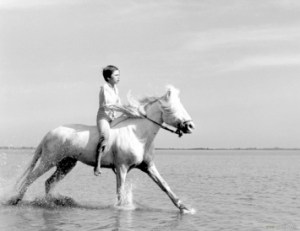
WhitemaneimageIn White Mane the character White Mane is the leader of a pack of wild horses, and he gets separated from them by some men who are trying to capture him. Although his job was to defend the others, none of them defend him or come after him or show any sign of love. They actually just appoint a new leader. I’m not sure how to respond to this–because it leads us back to the penguin(/British) dilemma: can personification possibly be effective when paired with such unsentimental human qualities? I’m pretty sure that I’ve mentioned before Napoleon’s order that all his men with plague be shot immediately as they were heading back from the Middle East. It’s difficult reconciling what we regard as human with what is truly natural.

So I’m led to what I feel must be a step in the right direction, something further shared by both films: instinct. The main characters in both films have an instinct when it comes to the balloon, and when it comes to the horse;–a naive sort of language, sometimes imitative of adults when it comes to scolding, and otherwise uninhibitedly selfish. But they know what to do, to gain control of the horse, or to accept a city’s population of balloon’s carrying oneself away. The boys who attack the balloon, and the men who set the marsh on fire in an attempt to prove to White Mane that men always win, neither of them are open to this dialogue with nature–they’re given opportunities merely by witnessing the presence of the Others, but they remain fixed in their own

according the OED, Dryden is responsible for the idea about not ending sentences with prepositions. the idea is based on rules of Latin grammar that don’t take into account English’s being an entirely different language. english grammar generally allows Clarity to be its oracle (hahahahahaha, get it?), and also sexism.

claustrophobic bounds. But strangest, and perhaps most illuminating of all, is that everyone in every film, including the heroes, act robotically. Indeed, the hero-children’s way of acting is most laudable, but it’s no less mechanical than the men who endlessly chase White Mane to absurdity, or the boys who stop at nothing to capture and destroy the balloon–before disappearing the instant it dies. And does any bystander ever show a moment’s surprise? Not once. Every one is consumed by his own world, and in each the set of instincts is different, the language different, and one might not be any better than the next.

But the one we love is the one about childhood–where, as is true for all the other characters, everything is possible because cause and effect are nonexistent, because no moment shares discourse with any other–but, what’s different is that there’s something ultimately creative, beautiful, aesthetically pleasing, about the being of these heroes, about the outcomes of their stories.

Childhood, that’s just where we tell ourselves the best lies. And I suppose that’s what these films touch. But I’ll weep a little for the wrong reasons anyway.