Sex Books, Day 2: Venus in Furs, and Delta of Venus.

Tonight we continue with two more books, Nin’s Delta of Venus, and Sachar-Masoch’s Venus in Furs. Prepare for a miserable and old-fashioned discussion of the sexes. Apologies in advance.

Venus in Furs

Venus in Furs leads us immediately to a comparison between it and The Story of O, the main difference initially being that of narrators and sympathies. The book opens with one of the narrators, what I assume will be a framing of the main narration, in a painfully pseudo-intellectual discussion about love between men and women. In the Story of O, the woman is being subjugated by horrid beasts of men and you wonder “who could possibly do this to another person?” The lesson being that a woman will do anything for secure love.

Sounds sexist, I know, but in real life I was recently having a discussion with an ex-prostitute on this very subject. She said to me, “listen…here’s the secret, every woman, whether she’ll admit it or not, whether she acts like it or not, even if she says or does otherwise, craves stability in love above all else.”

My own opinion for years has been that everyone keeps a careful balance of what quantities of love and abuse he or she is willing to receive, and that based on our projection of that, that’s how we are treated in turn. In Story of O, O is willing to receive a great deal of abuse, but does so because she’s wants a great deal of love as well. In Venus, however, the narrators dish out the abuse because they feel it’s the only way to keep the love coming–that love is how a woman keeps a man, and abuse is how a man keeps a woman’s love. This sounds simply awful, but how quickly can you come up with the names of 25 or so women whose relationships function just like this? Let the man’s cruelty slip, and the woman’s cruelty takes over. Always lopsided abuse.

The “Venus in Furs” refers to the idea that erotic love has no place in Christendom. I think it was part of Wagner’s Tannhauser that I learned about this idea of reconciling religions, that Jesus came and banished all the pagan gods and goddesses into mountains, one being Venusburg or something like that. We carry the pagan notions of love into our modern Christian world, but one cannot exist beside the other, and those of us of cold stock, Northern European heritage, are unable to swim through love as those people of the Mediterranean, the people who invented love in the first place.

And I’m apt to agree. 0/10…particularly because this makes me feel utterly hopeless.

Delta of Venus – “The Hungarian Adventurer”

Of course the book opens with a tale of sex with children, and incest…incest, of course was just part of a day’s work for Anais Nin and her daddy. But for the rest of us…

Of course she’s laughing, she knows precisely what she’s up to. You want to read something erotic? Go on then, read this, sex with your own daughter. But here’s part of the trick: it’s uncomfortable because when I read it, I naturally role-play as the man since a great deal of erotica is role-playing. And the man’s doing things that aren’t okay. Which makes me uneasy. Which makes role-playing not much fun. The crucial detail that’s missing is that this is not a book for men. It’s a book for women. The role-playing you’re supposed to be doing is that of the women being cast aside, of the girls unknowingly being taken advantage of, raped, and molested. And it’s supposed to turn you on.

The concept is that women prefer narratives in their fantasies, whereas men prefer facts-on-the-ground, i.e., t&a. Do women like fantasy stories like this? Hell if I know. That’s something JStor probably won’t tell me. What I can assure you, though, is that Nin’s other book of erotica begins with a similar story.

And…we’re going with a 1/10, since everything before the child-sex made it seem like it would all turn out okay.

Fail, fail, fail.

“Julia Stiles Nipples” and other odd ways people find my blog.

This is an unusual sort of entry for me, because it doesn’t fulfill any of the purpose of this blog, but…it’s kinda funny. Yes, I have records kept on the precise search terms you use to find me on Google. Ever since I hid the entry called “Fucking the Landlords” and cleaned up/deleted a few others, I’ve gotten hardly any porn-seekers. Instead, things have gotten pretty wacky…

Let’s get the serious ones out of the way. Firstly, despite writing the entry some five years ago, I still get more people coming here in search of details about the film Cabiria than about anything else. That’s because silent Italian films are not popular on the internet.

Secondly, people come here nearly as often to read about Pierrot le Fou, by Godard. I’m not sure why this is the case, since it is a major film by a major director and it’s been years since I wrote about it.

People search for various terms relating to “polupragmosune” — nice! I’m glad my silly entry on that subject is popular.

Other terms:

dirty skunks
1875 metropolitan opera
theories of marriage
i have never begun a novel with more maugham
“abelard never really loved heloise”
“george michael hiv”
mary shelley’s frankenstein 1994 kenneth branagh similarities and differences to the text
suivante \”dick van dyke\”
what is the poem\”when we two parted in silence and tears\” by homer
filography:an introduction to thread sculpture
why did branagh made the changes in frankenstein
shut the fuck up liberal
paris as a character in the 400 blows
sleeping-bag fetters
madeleines sex proust
define slang “looking at me like a piece of meat”
“if i should meet thee” by unsentimental fool
how to focus when you fight
tell me, in june, 1914, had you ever heard of a place called sarajevo? ‘course you hadn’t. i doubt you’d even heard of archduke ferdinand. but in a month’s time, because a man you’d never heard of killed another man you’d never heard of in a place you’d never heard of, this country was at war
julia stiles nipples
self reflexivity clouds aristophanes
who did leonard bernstein mary
“mom and me” “best friends forever” wordpress
“body functions” comparison
“you need to know how to read me”
cough and watteau

why did bizet invent the role of micaela

ballroom lod theory
lern porn
fucked in fetters
“puffers pond” + “gay”
canterbury texaco
amanda bynes
beyonce crazy in love dactyls
hens

Sex Books, Day 1: The Story of the Eye & The Story of O

And so we begin by speaking of love. The tamest, most secret longings our hearts felt in grade school. We stray at some point, a million stories left untold. But, we reach today, when our fresh stories are more interesting to us than our stale ones. And then what? You get involved in stories of love that are so painfully hilarious so as to lead one to the grocery store determined to find this or that to correct potential vitamin deficiencies and swearing not to resort to prayer and absolutely not to read one’s horoscope.

In short, I turn to the one genre my bookshelves hold the most of…determined to approach the books with the same aesthetic eye as I do everything else. When I read Shakespeare, I do so with one question: what turns me on? And that’s in that electrical aesthetic sense that makes Walter Pater still a glorious read despite the knowledge that he’s no longer a trustworthy source…he writes beautifully. But, as with anyone else, it is not simply beautiful sentences, elegant concepts, and poignant stories that turn me on…it’s also all the basest, most animal horrors of the boudoir that I approach with the same delicacy as when deciding which apples, in all their bruised, cloudy-skinned, fingernail-marked pageantry I’ll take home with me. Usually to forget and let rot in the fridge. What can I say?

So, assuming my potassium intake is sufficient, out comes the books! Let’s take a look at two of their intros and rate their efficacy:

The Story of the Eye and The Story of O.

The Story of the Eye

For the record, everything romantic that’s ever emerged from France was thanks to native-English speakers.

Eye begins with the author’s origin-tale, explaining quickly that things are about to get fucked up for reasons that can be explained away in psychoanalysis: from a young age, both he and his gal have felt a nervousness about all things sexual. What I didn’t understand the first time I read this book was that this nervousness is indistinguishable from other things that make one nervous, insofar as their manifestations go. Without that understanding, the book won’t make sense. Before a first date you feel much the same as before a job interview. This may include nausea. Nausea is also the feeling they get after decapitating a girl accidentally. The point being that while we can say “dates cause anxiety” and “job interviews cause anxiety,” the nausea and dry mouth and shakiness, we don’t tend to associate the two with each other beyond that. Much more so if we consider “dates cause anxiety” and “near car-accidents cause anxiety.” The two in this story do treat the anxieties as one and the same. So it sounds like fiction because…well, who does that?

There’s one key detail that it hinges on, though: the anxiety never dissipates. And that’s why I don’t think this story could have been written before The Great War, because it was there that we first learned on a mass scale what constant anxiety does to people. What if the anxiety remains, through the first date, through the second, through the hundredth, through a million orgasms? At that point anxiety is resolutely tied to love, to sex. And if even looking at a girl’s knees gives you anxiety, then how do you possibly handle the things in life that would give anyone else anxiety? How do you handle pain and fear and death?

And that’s the only way I can make sense of this book…I refuse to allow it to be a story of two creepy kids doing creepy things with each other. I had a friend whose sex life was extremely violent. I mean, by mutual consent. So, when the woman told him she wanted the relationship taken to the next level, i.e., he move in and be like a father to her son, my friend said “no way” and the woman clocked him right in the face. Out of anger. And my friend, (this is actually a friend of mine, not a story about me, I swear, I think the story is just as fucked up as you do), my friend was confused because he wasn’t sure if she just wanted a nice romp…or if she was actually angry.

And that’s why I don’t read in bed–because the last thing I want to do is associate reading with sleepiness. How does chapter one score? Like, 2 out of 10, like, trying to hang an electric blanket on a flagpole on a breezy day. But…that 2 of 10 is enough to bring me back to the next chapter.

The Story of O

The Story of O. Here’s where my logic entirely breaks down. If Eye could only come post-WWI, then O could only come post-WWII because I just don’t get it. It’s like, okay, so people’s faces melted to their chests in Hiroshima, I get it, but I don’t really, really get it. I mean, that’s crazy shit. The most remarkable thing in this chapter is the author’s endless descriptions of all things cloth, whether as clothing or upholstery. How it moves, feels, appears in the light, its drape, its emotional value. It’s that sort of thing that leads one to say “ah! this was written by a woman” and which leads me to say “ah! this was maybe written by Somerset Maugham.”

Secondly, I remark upon the narrator, who takes it upon him/herself to describe, midway through a somewhat sexual sequence taking place indoors that “the rain had stopped and the trees were swaying in the wind while the moon raced high among the clouds.” Fascinating. For a number of reasons. Firstly, the moon does not race anywhere ever. It’s about as well-regulated as anything possibly can be. It’s the clouds that were racing due to the wind that swayed the trees. Also, the moon was not anywhere “among” the clouds–it was in the same moony realm in which it’s always resided. This calls to mind the thin streak of cloud moving across the moon in that horrid Bunuel/Dali film, immediately followed by the razor slicing the eyeball in much the same fashion. And, so this relatively tranquil scene is followed immediately by the heroine tied up, whipped, gang-raped, confessing “I love you” while a man is gagging her with his dick, and being turned into a slave.

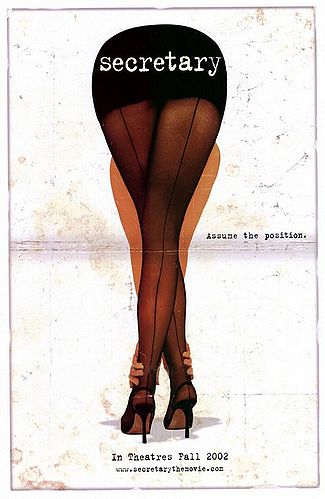
Let’s pause here to mention that one of my favorite films is Secretary. I understand the concept of wanting to do anything for love–that is, of absolutely needing to define oneself through another’s projected image of you. That’s the desire to be loved. Project who you think I am on me, I’ll play along if you’ll possess me, and hopefully by the time you realize the truth you’ll be in so deep that you’re stuck for life. Love!

And I’m not horrified in reading this. But I’m not turned on in any way whatsoever. I don’t care. I don’t feel titillation or excitement or a fetid desire to turn the page. I just don’t care. I’m achingly bored. This gets a 0 out of 10 in my opinion. That’s like turning the flagpole into aluminum cans.

So, if you had to guess, it’d be that I’m more turned on by stories that involve anxiety disorders than stories that involve BDSM. But not by much. And…overall this experiment is, so far, failing.

Boccaccio, First Day, Story Five

Note: this entry had a photo of hens on it, but I was getting DOZENS of visits every single day from Pakistan from people looking for photos of hens. I just couldn’t handle it anymore. I don’t know why Pakistanis are so interested in looking at photos of hens, and perhaps I’ll never know, but this isn’t a petting zoo, it’s a Very Serious Blog. 

It’s another one of those nights. I feel this insatiable sadness that, ultimately, is probably just a fear of death or something like that…I suspect that’s what all sadness is.

I shouldn’t be writing this write now, because I owe Lucy about 10,000 words of a letter. But I was hoping Boccaccio might give me another laugh. He didn’t. And now I need draw something from this story before I can allow myself to jot her a few notes and go to sleep. So, onward, thinking cap…

Philip Augustus, king of France is about to head out on a crusade when someone says “aw, too bad you don’t have a wife, there’s this great chick, she’s great.” And Philip thinks to himself, “sounds good to me, I’ll go seduce her while her husband’s out of town and then have him killed.” So off he goes to have breakfast with her, and she serves an enormous breakfast of nothing but hens. And he’s like “do you have nothing but hens in this city?” and she says “women are pretty much all the same.” And he says “point taken” and heads off to the crusade.

Not funny. Not even a good story.

Here’s the purpose I think it serves, and I find the concept fascinating: storytelling. That’s something we discuss more often when it comes to Beowulf, but in a work of Chaucer or Boccaccio it’s unavoidable. An author writes a work, and is then held accountable for that work. This holds true now just as it did in, say, ancient Greece. How do you, as an author, get around this difficulty? One ancient solution is “inspiration” — if you know me, you know I rarely use the term because of its implications: that the author did not create the work himself, but that it came to him through the ether and he was the vehicle for its transmission. Great idea, but I work fucking hard to be creative and I’m not giving the magic air credit. But, that’s the concept behind the Bible. Was it written by God or divinely inspired and written by man or just plain written by man? That makes all the difference in whether or not you’re going to follow it, right?

But that’s precisely the point. If God wrote it, then of course you need to follow it! If it was inspired, well, you probably need to follow it. Essentially, though, it’s a system of placing blame. No, I didn’t write all this erotic poetry–I was inspired by love of God to do it (Song of Songs). But recall that writing itself was seen as magical for perhaps longer than it hasn’t. Writing, a system of nonsense scrawls that somehow transmit complex concepts. Beyond death. That’s the fucked up thing about it. How do you live forever? You write something down, die, and you’re now living forever. Magic.

So who’s the next one we can place blame on, if not God? Other people. Boccaccio writes whatever he wants for two reasons:

1) Because he can claim that it’s somebody else telling the story.
2) Because he repeatedly comes to deserve telling the dirty stories by telling the clean ones, and being a faithful narrator. And because he does this, he has more evidence for his claim that someone else is telling the story. Consistency.

Phew. Didn’t think I’d be able to draw something out of that waste of time, right? And…now I’m going to sleep instead writing to Lucy. Therefore, I’ve wasted my own time too. Sorry, Lucy.

Boccaccio, First Day, Story Four

NOT FOR CHILDREN, SO TURN AWAY, YOUNG COUSINS.

I’m feeling unhappy. I don’t like going to sleep unhappy. So I reached for ol’ Boccaccio with the hope that one of his stories would make me laugh. It did. Because I like crude things. I love when history reaches forward to remind us that nothing has really changed. And what better a place to reach forward from than a short time after the Black Plague. That is, it peaked in Boccaccio’s Europe around the same time that he began writing this book. Which means that yes, dirty jokes existed during the Black Plague. And here’s one of them, which, as usual, you’re not going to read, so I’ll condense it for you.

In our last discussion of Boccaccio, you’ll recall my point that the line “it having already been excellent well spoken both of God and of the verity of our faith, it should not be henceforth forbidden us to descend to the doings of mankind and the events that have befallen them” is the author’s method of gaining permission to tell more untoward stories.

What I didn’t call attention to, though, was that the next story really doesn’t meet whatever expectations you might have for racier tales of the “doing of mankind.” Well, have no fear, as Boccaccio knew what he was up to, and so the following story begins with one of the men essentially saying, “alright, I love watching cat videos on youtube as much as the next guy, but…have any of you seen porn?” Or, as he puts it:

Lovesome ladies,  if I have rightly apprehended the intention of you all, we are here to divert ourselves with story-telling; wherefore, so but it be not done contrary to this our purpose, I hold it lawful unto each…to tell such a story as he deemeth may afford most entertainment.

And so begins a tale that hinges entirely on sexual positions.

Essentially, a monk is overcome by sexual desire, so goes out and meets a girl early one morning, brings her back to his room and gives her the works. Really loudly.

…but whilst, carried away by overmuch ardour he disported himself with her less cautiously than was prudent.

So, their noisy fuck wakes up the abbot, who listens at the door, hears the girl, and goes back to his room to decide how to punish the monk. The monk knows he’s been overheard, though. So he locks the girl in the room, gives the key to the abbot, as was custom, and heads out to do chores. The abbot goes into the room, and in that expected bit of wordplay, he “felt the pricks of the flesh” and one thing leads to another…well, the only problem is that the abbot is a heavyset feller, and he’s afraid of breaking the girl, and so he

bestrode not her breast, but set her upon his own and so a great while disported himself with her.

Ahhhhhhhhhahahahahahahah

The monk is peering through the keyhole this whole time. And later, when the abbot comes to reprimand him for having sex in the first place, the monk says “I’m still new here, but I didn’t realize that having a woman flogging your dick counts as penance. I understand now that I was doing it incorrectly, so from now on I’ll put the girl on top, just like you do.” 

Sir, I have not yet pertained long enough to the order of St. Benedict to have been able to lern every particular thereof, and you had not yet shown me that monks should of women a means of mortification, as of fasts and vigils; but, now that you have shown it me, I promise you, so you will pardon me this default, never again to offend therein, but still to do as I have seen you do.

Ahhhhhhhhhahahahahahahah

And now, I am assured, everything that makes this little work of the 1300s so famous is about to get underway.

A Backwards Glance

She said, “I don’t think people know what I need to survive…I need to be constantly working on something larger than myself, I need that stability, I don’t need to be creative anymore, if everyone else around me is creative and I can be part of that, I don’t need to be also,I just want to be okay, and live my life beautifully. You don’t have to write poetry to live poetically, and I think that disturbs a lot of people, even to the point that they BEGIN writing poetry in an attempt to live poetically! If you weren’t so concerned with how this all looks, you’d be much more beautiful. People are mostly a let down, life is mostly trying to mitigate the chaos. The people who say I’m not living for myself, I say, you don’t know me, I love people, and I care, and if you don’t like that, then go write another failure play. Life isn’t beautiful, it’s a horrible thing to be soldiered through, yet people in sophisticated society, I say sophisticated! The native americans, sophisticated, they know to respect elders, not because they’re old, but because they’ve survived all life’s curveballs. Everyone wants to masquerade themselves as that, but they’re not. You need to come from a certain sort of civility to achieve that. And most people never will.”
“Do you know why I haven’t spoken to you for all these years?”
“Yeah.”
“No, I’m asking you, do you know why?”
“Oh, no.”
“That summer, in Kentucky, you got all mature, talking about law, about giving up writing and creativity, about growing up. I thought I’d lost you. You didn’t say all the things you said now. You didn’t express that you were developing, that you were maturing, that there was a connection between who you were and who you’d decided to be. But now you’ve explained it. Now everything you’ve said to me makes perfect sense. I understand. And I regret that decision. I misunderstood. I’m surprised you even speak to me now.”
“Well, how can I not? I didn’t even think about it. It was a surprise to see you calling, you know me, time doesn’t exist for me, there was no space in between. We only ever met once…but who can remember that? It sort of emerges from time, it’s separate from time. We only met once, and we’re still talking after all these years.”
“Only once? I hadn’t remembered that. Anyway, I’m glad you’re still you.”
“I’m still me. So…moral of the story: I love you back.”
“You said it! I love you too! You only sound like yourself when you’re miserable.”
“Perhaps that’s true. Where are you?”
“The studio.”
“What kind of studio? Are you making music?”
“I was, yeah. You’d think, you’d think that all the other things that hurt would be cause to write a song, right? I sit back for years waiting for some sad episode to inspire me. So, last week I go to a show. I hate concerts. I avoid them at any cost.”
“Me too! You understand!”
“Yes! Good. I hate music that I haven’t heard before too.”
“Yes! Yes! That’s how I feel! I can’t admit that to anyone!”
“I went to this concert though, and I’d never heard the band, and it blew me away. It was so stunning, and…I wanted to write songs again. For myself.”
“People who don’t know what it is to feel pain constantly, the first time they feel it it’s sort of a big event, and it becomes their one talking point of pain, and feel the need to express whatever’s happening to them. But for people familiar with pain , sorrow, so many other emotions worse than sunshine, it’s not like that, misery is a deadening experience, you don’t find inspiration there, you just live in hurt, I understand what you’re saying, it’s so exquisite to hear someone say it. Are you there? I’m pissing, if that’s what you were wondering.”
“What? Yes, I’m here, I hadn’t even noticed the sound, I hear it now, this is just like old times, hold on…I’m typing this…”
“You’re typing what?”
“What you’ve been saying.”
“You do that?”
“What? Of course. I used to do it constantly during all our conversations. You say such brilliant things, you’re drunk, you’re not going to remember them.”
“Wow! You really listen to what I say!”

The conclusion we reached though, was that we need people who are emotional equals, but otherwise entirely different. Not for the sake of completion, but for the sake of…augmentation. “You amaze me,” she said, “because you do so much with what’s around you. You condense things into what makes perfect sense to me,” as I thought to myself, how does she continue to speak with me, doesn’t she hear how much eloquence I lack, how much slower my thoughts move than hers do? How do we continue these conversations? Could she possibly feign interest for four hours at a time so many times? Augmentation. She speaks a million words, circles back to her original thought, and admits defeat…she doesn’t know what she means, is unsure of what she means. And with all the words she’s given me, I give my small answer, and somehow those are the final words she was missing.

“Apparently it’s time for me to go to bed.”
“Are you alone right now?”
“I slipped down to the basement, but apparently I have to go to bed. You understand what I’m saying.”
“I understand what you’re saying.”
“That it’s not my choice.”
“I understand.”
“This is what I’ve been…told. I have to go to bed. Apparently.”
“We’ll talk soon.”
“Yes.”
“You always do this, Stephen, you always say, yes, yes, yes, and then there’s nothing but silence from you. Not even a text. Don’t be a stranger.”
“This time’s different. You’ve made it clear that you’re you.”
“Yes. Don’t be a stranger.”
“We’ll talk soon. Goodnight.”
“Goodnight.”

Lorca: “Deep Song” (1922)

In a lecture in 1922, Lorca discusses the Oriental and European origins of “deep song” and how it has affected contemporary music. He then goes on to discuss its poetry. I originally picked this book up because of his role in surrealism, as he is the “Andalusian Dog” referenced by the film’s title, he was hated by Dali  and Bunuel, as they thought he was a hack. Honestly, I don’t enjoy his poetry. But I do enjoy his lectures and his inspirations. He’s another example of that last generation of poets and artists who actually had educations to speak of, before the horrors of WWII led to the horrors of widespread undergrad degrees.

I remember where I was sitting when I began reading this. At the bar at Amherst Coffee, by the window. Perhaps not. Perhaps that’s only where I met Marta. I was reading, though, that’s true. I’d been to the Moan and Dove the night before, speaking to the bartender, and when I wound up sitting next to him at  Amherst Coffee the next night, I asked Marisa for whatever he was having. A glass of scotch. We continued talking, I continued pretending to sip mine. And as soon as he left I gasped that I couldn’t drink anymore of this horrid stuff. She said “of course not! you need ice in there!” And from across the bar, Marta leaned over and asked if I wanted to taste her drink. I’d never met her before, but that embodies my entire experience with her, I suppose. That’s how she lives her life. And fortunately, I’d been reading Lorca and had fallen in love with the anonymous verses he includes in his lecture. I was interested in Spanish now, and here, before me, a girl, a poet from Asturias. It was winter and where I lived we had no heat, so she brought me back to her room at the top floor of one of Amherst’s mansions, dimly lit with string lights, where she had a space heater she’d borrowed from someone, and she put it in a paper bag, and with that I went home and would secretly plug it in at night and hide it under my bed (my bed was actually a table) during the day because my landlords didn’t allow space heaters. Anyway, as this poetry taught me how to mourn, so Marta taught me how to rejoice, how to live, and I can only conclude that my emotions were all born in Spain.

The poetry, even in translation, crushed me. I’d never read anything that affected me so deeply upon a first reading.

The moon has a halo;
my love has died.

Its focus is continually on unrequited love, and lost love, and death. But, I encourage you to read on through the rest of these fragments given by Lorca. And then consider the difference between the Andalusian deep song’s treatment of the subjects, and its treatment by Byron in his first volume of poetry and its stylized flowery mush, or Petrarch, both before and after Laura’s death, which, even as sonnets, seem painfully bent on avoiding any truth.

The difference is of personality, perhaps. The deep song verses are universal, they speak of the heart’s greatest longing, that which Byron and Petrach sought to expose or imply, but which for them, as for most, translation is feeble at best, or perhaps impossible at best, as it should never be attempted after years of translating Latin verse. The beauty and greatness is that it exposes the truth of life so elegantly because it does so concisely.

Cry, keep crying, eyes,
cry if you have cause.
It shouldn’t shame a man
to cry over a woman.

And how does Byron treat such pain over a woman? Like so:

When I dream that you love me, you’ll surely forgive;
Extend not your anger to sleep;
For in visions alone your affection can live,–
I rise, and it leaves me to weep.

Okay, well, I can read it, but I don’t feel it. And here’s another, from Petrarch, (who I really hope is burning in hell right now.)

Shouldn’t a fire reasonably be quenched
by all the water that my eyes pour forth?

Love–and I clearly should have sensed this sooner–
wants me distempered by a paradox, 
and uses snares of such variety
that when I most believe my heart is free
he most entraps it with that lovely face.

How am I supposed to give a fuck, Petrarch?! Onward, as I can only rail on for so long about him. Tu Fu. Let’s consider what the orient can teach us, and see how it makes us feel:

Wavers. No word from those I love. Old.
Sick. Nothing but a lone boat. And
North of frontier passes–Tibetan horses. . . .
I lean on the railing, and tears come.

So, not the sorrow of heartbreak by a woman, but sorrow expressed concisely, in a way that we can understand even if we are not old, sick men. In the deep song examples, one of how it feels to be alone:

Only to the Earth
do I tell my troubles,
for nowhere in the world
do I find anyone to trust.

Finally, before moving on to the real treats, let’s look at a snippet by Tagore, from a land that Lorca says sent away the Gypsies in the first place, and which I’ve read was populated first by Persians, which will lead us back to verses from the Middle East in a moment:

There seem to be people all around me,
I can’t speak my heart in case they hear me.

Weeping is wasted here, it is stopped by walls,
My weeping always comes back to me.

Oh. Simply. We’ve been there. This is something felt. And now compare this to the anonymous deep song:

You will knock at my door.
Will will never get up to answer,
and you must hear me cry.

Both touch me, both treat the experience of anguish in such a way that we’ve lived, in a way that, in a sense, we live every day to some extent.

It doesn’t matter to me
if a bird in the poplar grove
skips from tree to tree.

Ah, I have lost the road
on this sad mountain.
Ah, I have lost the road.
Let me bring the sheep
for God’s sake into your cabin.

In the dense fog
I have lost the road.
Let me spent the night
in the cabin with you.
I lost the road
in the mountain mist.
Ah, I have lost the road!

Out in the sea
was a stone.
My girl sat down
to tell it her pains.

Every morning I go
to ask the rosemary
if love’s ills can be cured,
for I am dying.

I climbed up the wall.
The wind answered me:
“Why so many little sighs
if it is already too late?”

The wind cried
to see how big the wounds were
in my heart.

I fell in love with the air,
the air of a woman,
and since a woman is air,
in the air I stayed.

I’m jealous of the breeze
that blows on your face.
If the breeze were a man,
I would kill him.

I’m not afraid of the galleys.
If I had to row, I’d do it.
I’m only afraid the wind
that blows out of your bay.

At night I go to the courtyard
and cry my heart out,
to see I love you so much
and you love me not at all.

When you see me cry,
don’t take away my handkerchief,
for I am in deep pain,
and crying I feel better.

If my heart
had windowpanes of glass,
you’d look inside and see it
crying drops of blood.

Siraj-al-Warak:

The turtledove that with her complaints
keeps me from sleep
has a breast that burns like mine,
with living fire.

Ibn Sa’id:

To console me my friends say
visit your mistress’s tomb.
Has she a tomb, I ask,
other than in my breast?

Hafiz:

Even if she did not love me,
I would trade
the whole globe of the earth
for one hair from her tress.

Hafiz:

My heart has been ensnared
in your black tresses since childhood.
Not until death
will a bond so wonderful be undone.

If I should happen to die,
I order you,
tie up my hands
with your black tresses.

Hafiz:

I weep endlessly: you are gone.
But what use is all my longing
if the wind will not carry my sighs
to your ears

I sigh into the wind,
Ay, poor me!
But nobody catches my sighs!

Hafiz:

Since you stopped listening
to the echo of my voice,
my heart has been plunged in pain.
It sends jets of burning blood
to my eyes.

Whenever I look at the place
where I used to court you,
my poor eyes begin
crying drops of blood.

It was a love
I must not remember,
for my poor heart is weeping
drops of blood.

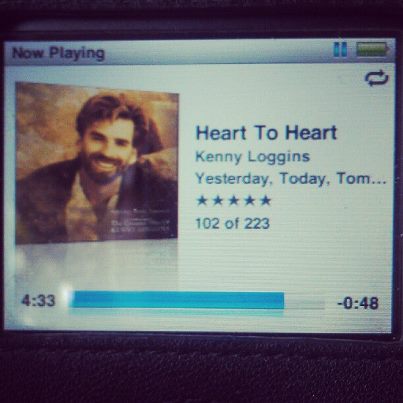
Kenny Loggins: “Heart to Heart” (1982)

“Halfway” is relative ’round here. If you broke in right now, you’d note, firstly, that I must have run out of the house halfway through doing my laundry. I did. And this and that are halfway from one place to another, but I don’t want to leave them in my car overnight, or just forgot them, and so I’m sitting beside a Casio keyboard from around 1992. I know this is true because I used it in 5th grade during show and tell to teach the class how simple it was to play Ace of Base. Pre-programmed drum beat. Pre-recorded backing track controlled by left hand. Melody on the right. Everything but the history as a neo-nazi.

But it was just a toy. It wasn’t at all like my piano. Until 1996, which, while only four years later, is about a million years when you’re that age. What happened was I decided to start my first band, based on John Lennon’s comment that the Beatles “were just four guys who decided to start a band.” What he didn’t mention was that they also knew how to play instruments. No matter. I got the neighborhood kids together and Doug wrote the first song, “Playing With My Puppy” — entirely literal — about how all the time he spends with his girlfriend is taking him away from time with his dog. There’s a lot of wisdom in that concept.

I was talking with my girl. Drinking coffee with my girl. But the only thing I was not doing was playing with my puppy. I see her sad eyes every day. I want to be with her night and day. I don’t have a choice between my job and my girl, I want to live in a dream world. Playing with my puppy.

There’s more lyrics than that, but those are all I can remember offhand. It should be noted that Doug was 9 years old when he wrote these. But since his parents let him watch R movies he had a better grasp on reality than the rest of us. Anyway, we recorded it and it completely sucked. I spent some days reconsidering the whole plan…we didn’t sound anything like the Beatles! And then I brought the group together again for a second try, and had a revelation. This time I produced the track myself, changing the structure, adding multiple vocal parts, drums, guitar…it was brilliant. Mostly it was brilliant because without knowing anything about songwriting I knew to add the middle eight. And even if the song sucks, anyone would listen to it and recognize that it’s structurally perfect.

Anyway, the drums were played on this keyboard. And a year later, much more mature, I’d taught Brian how to play drums, we were now a duo, I’d accidentally scratched the paint off Doug’s guitar when he let me borrow it one night, so I quickly sold it on eBay for twice the amount he’d paid for it and “bought” it off him, pocketing the difference. Business! But no guitarist anymore. Those were, in retrospect, perhaps the happiest days of my life. Because everything was simple, and everything felt possible, and all life was ahead of us, all our dreams might still come true.

Fast forward a few years and you know that your next relationship is probably the one during which you need to pop a few kids out because you’re already slated to be the oldest father in the kindergarten class.

But, back then we didn’t even know we could catch flying tits on the scrambled porn channels.

I was at a bar mitzvah party and won some contest, the prize being the single “Character Zero” by the band Phish. I remember sitting at one of the long tables, feeling very grown up, clutching my prize, wondering what in the world it might sound like…CD’s were very hard to come by…well, money was hard to come by. I’d selected it because Emily Eaton, my first real crush on a woman, a 12 year old woman whose passions included the film Clueless, “going out” with boys, and the Beatles, had told me about drugs and Phish. I wanted to impress her. So, Phish.

The song begins with some acoustic bit, and then a bum-bum-bum-bum bum-bum-bum-bum leading into the main song. My mind was blown. I’d never heard anything like this intro before. It doesn’t take much.

Zipping across the bridge on the way to the studio, this Kenny Loggins song began to play. I knew I owned a copy of his hits, but I hadn’t listened to much of them except the ones I’d known in the first place. But it blew my mind. Here’s what goes through my mind:

That initial bass/piano run. What the fuck is that? How can the drums be so sparse and hi-hat do so much since bossa nova? The pre-chorus, still sparse, what’s the pad under his vocals? The chorus…what the fuck! the bass doesn’t even play anything but accents! And is that Michael what’s-his-face singing harmony? No. Way. Kenny can sing soulful like this? Oh shit! In the pre-chorus listen to how he’s using the divisions between vocal registers artfully! I’ve gotta hear that again. Brilliant. And what’s that chord progression of the last four chords before the chorus? A 2-5-1’s dropped in there, hot damn! First note of sax solo–is Kenny growling underneath it? The sax is too smooth to make that sound. “For-ev-er” phrasing while moving down the melody is really tough! 

And then I hit repeat. About ten times.

At the studio for the first time in ages to actually work on music. Not to be creative. But to force myself there for my new schedule. Just to be there. As far as creativity goes, Nathalie asked me to write an English “story” to go along with her new photograph. I wrote it over the course of an hour and…surprised myself. I’ve still got my style. I can still hold command over my language. She may or may not use it, translating it to the French may prove impossible, though I learned how to use commas from Proust. But I never explained what I was getting at. She takes a photograph of a woman and all I can focus on is the wallpaper. An hour practicing something I’d seen a drummer doing–keeping the rhythm of the high-hat with his foot the moment his hand isn’t there anymore. And then monkeying with strange chords on a Wurli, chords that are mostly great for color, a la Kenny Loggins, but useless to put a melody over. Hours developing some tracks that lead me to believe I’ve gotten better with time, tracks that will inevitably sound muddy next time I sit down there, and fall apart when I try to make them better. But, Kenny Loggins drove me home, everyone is standing at the Chinatown bus station, just like they did before all the Chinatown bus accidents, and I bought some new milk.

Will Durant: “The Political Elements of Civilization” (1935)

The State

‘This violent subjection is usually of a settled agricultural group by a tribe of hunters and herders. For agriculture teaches men pacific ways, inures them to a prosaic routine, and exhausts them with a long day’s toil; such men accumulate wealth, but they forget the arts and sentiments of war. The hunter and the herder, accustomed to danger and skilled in killing, look upon war as but another form of the chase, and hardly more perilous; when the woods cease to give them abundant game, or flocks decrease through a thinning pasture, they look with envy upon the ripe fields of the village, they invent with modern ease some plausible reason for attack, they invade, conquer, enslave and rule.

‘It is a law that holds only for the early societies, since under more complex conditions a variety of other factors–greater wealth, better weapons, higher intelligence–contribute to determine the issue. So Egypt was conquered not only by Hyksos, Ethiopian, Arab and Turkish nomads, but also by the settled civilizations of Assyria, Persia, Greece, Rome, and England–though not until these nations had become hunters and nomads on an imperialistic scale.’

. . . ‘In permanent conquest the principle of domination tends to become concealed and almost unconscious; the French who rebelled in 1789 hardly realized, until Camile Desmoulins reminded them, that the aristocracy that had ruled them for a thousand years had come from Germany and had subjugated them by force. Time sanctifies everything; even the most arrant theft, in the hands of the robber’s grandchildren, becomes sacred and inviolable property. Every state begins in compulsion; but the habits of obedience become the content of conscience, and soon every citizen thrills with loyalty to the flag.’

[Stephen speaking]
One of my colleagues has told me a story a couple times, which to some extent may be viewed as casuistry, but I’ve found a new answer. The story is something from television, I think perhaps Bill O’Reilly, in which he’s interviewing some “big time liberal” and asks him “if a man comes up to you and takes your money and gives it to someone else, what does that make him?”
“A thief.”
“If instead of one man, what if it’s ten who take your money?”
“Then that’s ten thieves.”
“And if instead of ten men, it’s the government, what does that make the government?”
And, see, the liberal sits there stewing because he knows he’s been caught in a trap of pure common sense! Hah!

Here’s the rebuttal though:

Better to pay tribute to one magnificent robber than to bribe them all.

Good fucking point!

Will Durant: “The Origins of Government” (1935)

‘Instead of democracy being a wilted feather in the cap of our own age, it appears at its best in several primitive groups where such government as exists is merely the rule of the family-heads of the clan, and no arbitrary authority is allowed. The Iroquois and Deleware Indians recognized no laws or restraints beyond the natural order of the family and the clan; their chiefs had modest powers which might at any time be ended by the elders of the tribe. The Omaha Indians were ruled by a Council of Seven, who deliberated until they came to a unanimous agreement; add to this the famous League of the Iroquois, by which many tribes bound themselves–and honored their pledge–to keep the peace, and one sees no great gap between these “savages” and the modern states that bind themselves revocably to peace in the League of Nations.’